.htkc-tbl{overflow-x:auto;-webkit-overflow-scrolling:touch;margin:22px 0;max-width:100%}
.htkc-tbl table{width:100%;min-width:600px;border-collapse:collapse;font-family:Montserrat,Roboto,sans-serif;font-size:15.5px;color:#333}
@media (max-width:700px){
.htkc-tbl table{min-width:0!important;font-size:13px;line-height:1.55}
.htkc-tbl th,.htkc-tbl td{padding:8px 7px!important;word-break:normal!important;overflow-wrap:break-word;-webkit-hyphens:auto;hyphens:auto}
}
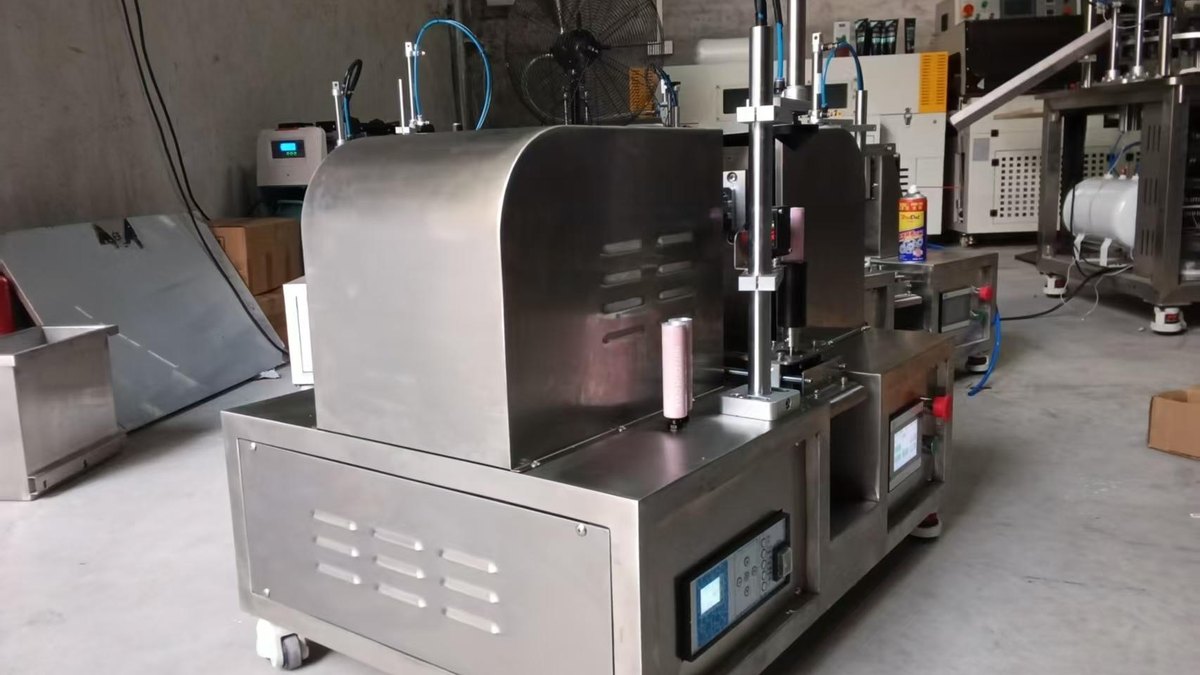
A tube filling and sealing machine doses your product — cream, gel, ointment, paste, or toothpaste — into a tube and seals the open end, ready for coding and packing. This is the complete guide to tube filling and sealing: how the machines work, how to choose the right one for your tube material and output, what accuracy and speed to expect, and what it costs. It links to our full library of detailed guides so you can go as deep as you need on any topic.
If you are specifying a machine for the first time, read the six steps in order — each one narrows the choice, and by Step 6 the model, the tooling and the output are usually obvious. If you already know your tube format, jump straight to the step that is still open.
How a Tube Filling Machine Works
At its core, the machine does three things: it holds the tube, it doses a precise amount of product into it, and it seals the open end. The sealing method depends entirely on your tube material — plastic and laminated tubes are heat-sealed, aluminium tubes are folded, and some machines use ultrasonic sealing for a clean, consistent bond. Getting this match right is the single most important decision in machine selection.
Around those three actions sits a fixed sequence that every tube line follows, whether it runs eight tubes a minute or fifty:
- Tube loading — tubes are picked from a magazine or placed by hand, then oriented so the cap faces the right way and the print is aligned.
- Registration — an optical sensor reads the colour mark on the tube shoulder so the seal runs square to the artwork. Without this, sealed tubes look crooked and reject rates climb.
- Filling — the dosing system dispenses the set volume into the open tube tail.
- Sealing — heat, ultrasonic energy or a mechanical fold closes the tail, depending on material.
- Trimming and coding — the excess tail is cut clean and the date or batch code is stamped in the same station.
- Ejection — the finished tube drops into a tray or transfers to a cartoner.
The dosing system is what separates one machine from another in practice. Three types are common, and the choice affects both accuracy and what products the machine can handle:
| Dosing system | Typical accuracy | Best for |
|---|---|---|
| Servo piston | ±1 g across the range | Creams, gels, ointments and pastes — the most common choice on tube fillers |
| Ceramic rotary pump | ±1% at higher speeds | Thin liquids and larger volumes where speed matters more than gram-level precision |
| Pneumatic | Wider tolerance | Entry-level or semi-automatic machines, non-critical fills |
Everything else on the machine — the PLC, the HMI, the frame — exists to run that dosing system repeatably and to keep the tube aligned while it happens. When buyers compare quotes, the dosing type and the number of stations explain most of the price difference between two machines that look identical in a photo.
Step 1: Match the Machine to Your Tube Material
Your tube material dictates the sealing technology, which dictates the machine. Start here:
- Plastic, laminated or aluminium tube — choosing the material
- Laminated vs all-plastic tubes compared
- Ultrasonic vs heat sealing — which process your tube needs
- Aluminium tube folding machines explained
Three tube families are in commercial use, and they are not interchangeable on the same sealing station. A machine built to heat-seal a plastic tube cannot fold an aluminium one, and the tooling is different again.
| Tube type | Sealing method | Barrier & feel | Typical use |
|---|---|---|---|
| All-plastic (PE / PET) | Heat seal or ultrasonic weld | Moderate barrier, squeezable, lowest unit cost | Hand cream, shampoo, body lotion, gels |
| Laminated (ABL / PBL) | Ultrasonic weld (preferred) or heat seal | High barrier against oxygen and aroma, premium print finish | Toothpaste, pharmaceutical ointments, cosmetic actives |
| Aluminium | Folding and crimping | Total barrier, holds shape under pressure, dents if handled roughly | Ointments, adhesives, artist colours, pharmacy creams |
Tube dimensions drive the tooling as much as the material. The standard range across HTKC machines covers 15–50 mm in diameter and 50–260 mm in length, with change parts available so one machine can run several tube sizes. If you run more than two diameters, budget for a second set of change parts at the outset — swapping tooling mid-shift is possible but costs production time, and having the parts on the shelf is cheaper than ordering them later.
One point that catches first-time buyers: fill accuracy is set by the dosing system, not the tube material. A servo piston filler holds ±1 g whatever tube you run it with. What the material changes is the sealing station and the reject rate — a badly matched seal shows up as leaking, wrinkled or crooked tails, not as weight variation.
Step 2: Define Your Output and Automation Level
Output ranges from a few tubes a minute on a semi-automatic machine to dozens on a fully automatic line. The right choice is driven by your daily volume and how many tube sizes you run:
- Semi-automatic vs fully automatic tube filling
- Machine output: picking the right speed
- Small-batch filling for startups & pilots
- Building a complete turnkey filling line
Quoted output is always a rated range, never a single number, because the real figure depends on fill volume, product viscosity and how the tubes are loaded. Use this to convert a rated speed into what you will actually get in a shift:
Daily output = rated tubes/min × 60 × productive hours × 0.85
The 0.85 allowance covers changeovers, cleaning, breaks and minor stoppages. Ignore it and every machine you compare will look 15% faster than it is.
Worked through: a semi-automatic machine rated at 10 tubes/min, run for one 8-hour shift, gives roughly 4,000 tubes a day. A fully automatic machine at 30 tubes/min on the same shift gives roughly 12,000. That gap — three times the labour-free output — is what you are paying for when you step up.
| Consideration | Semi-automatic | Fully automatic |
|---|---|---|
| Tube loading | By hand, one at a time | From a magazine, automatically |
| Typical output | 7–13 tubes/min | 20–50 tubes/min |
| Operators per shift | 1 dedicated to loading | 1 supervising the line |
| Changeover to another tube size | Fast, mostly tooling | Longer — magazine and guides reset too |
| Makes sense when | Under roughly 8,000 tubes/day, or many small batches | Above roughly 10,000 tubes/day on a stable product |
The crossover sits somewhere around 8,000–10,000 tubes a day. Below it, a semi-automatic machine plus one operator is cheaper to buy and cheaper to run. Above it, the labour saving from automation usually repays the price gap within a year or two — which is why the honest answer to “which one” is a volume question, not a budget question.
Step 3: Understand Accuracy and Seal Quality
Two technical specs decide whether your product is profitable and consistent: fill accuracy and seal integrity.
- Fill accuracy: what ±1 g and ±1% really mean
- How to inspect tube seal quality
- Tube sealing machine troubleshooting
A spec of ±1 g means every tube should land within one gram of the target weight. On a 100 g tube that is 1%, which is tight. On a 15 g tube the same one gram is 6.7%, which is loose enough to matter on a declared net weight. This is why good spec sheets quote accuracy as a percentage for small fills and in grams for large ones — and why a supplier who only ever says “±1 g” has not told you enough.
You can never fill below the declared net weight, so every line is set slightly over target. The looser the accuracy, the bigger that overfill has to be to stay legal — and on a line running tens of tubes a minute for a full shift, a fraction of a gram per tube becomes a real material cost over a year. Accuracy is not a vanity specification; it is a direct line item in your product cost.
Seal quality is the other half, and it is easier to get wrong because it is invisible until the product leaks in a carton. Three checks cover most of it: a visual inspection for wrinkles, incomplete welds and crooked tails; a squeeze test on a sample per batch to confirm the seal holds under hand pressure; and a leak or dye test on a destructive sample when the product is low-viscosity or the tube will be shipped long distance. Build the first two into the operator’s routine and the third into quality control — a machine that seals well is worth more than one that fills fast.
Step 4: Match the Machine to Your Industry and Product
Cosmetics, pharmaceuticals, food, and specialty products each put different demands on hygiene, precision, and packaging. Our guides cover the key applications:
- Tube filling machines by product type
- Filling creams & ointments
- Single-dose tube filling machines
- GMP hygiene requirements
- Tube vs bottle vs jar filling
The product you fill changes the machine more than the industry label does. A thick toothpaste and a runny lotion both go into tubes, but they need different dosing, different hopper design and often different sealing energy:
| Product | What it demands | Watch for |
|---|---|---|
| Creams & lotions | Gentle handling, no aeration, clean tail | Air pockets from over-mixing; product on the seal area causes weak welds |
| Ointments & gels | High-viscosity dosing, heated hopper if needed | Cold product will not flow evenly — check the viscosity at filling temperature |
| Toothpaste | High volume per tube, abrasive paste | Wear on pistons and seals; specify stainless contact parts |
| Pharmaceutical | GMP hygiene, cleanable surfaces, documented cleaning | 304/316 stainless contact parts, no exposed threads or crevices |
| Two-component (epoxy, hair dye) | Two fillers dosing one tube separately | Ratio accuracy between the two chambers matters more than total weight |
For pharmaceutical and cosmetic work, hygiene requirements usually decide the frame and finish rather than the filling principle: stainless steel contact parts, smooth weld seams, no fasteners where product can collect, and a design the operator can actually clean between batches. Tell the supplier which market you sell into before the quote — retrofitting hygiene features afterwards costs far more than specifying them at the start.
Step 5: Budget for the Real Cost of Ownership
The purchase price is only the start. Understand the full picture before you compare quotes:
- How much a tube filling machine costs
- Energy & maintenance cost
- Spare & wear parts to stock
- Maintenance checklist & SOP
There is no list price for a tube filling machine, because it is built to order. Six things move the number, and knowing which ones you actually need is how you compare two quotes fairly:
- Machine platform — semi-automatic or fully automatic, and how many filling stations.
- Dosing system — servo piston, ceramic pump or pneumatic; the servo option is the most accurate and the most expensive.
- Sealing technology — heat, ultrasonic or fold-and-crimp, matched to your tube.
- Tooling — one tube size is normally included; each additional diameter is a separate change-parts set.
- Hygiene level — stainless contact parts and cleanable design for pharmaceutical work.
- Peripherals — tube feeder, cartoner, coding unit, conveyor.
Running cost is the part buyers underestimate. A tube filler draws power for the servo drives, compressed air for pneumatics, and consumes wear parts — sealing jaws or sonotrodes, piston seals, trimming blades — on a predictable cycle. A machine that is slightly cheaper to buy but uses a non-standard sonotrode or a proprietary seal will cost more over five years than the one you almost bought. Ask what the wear parts cost and how long they last before you compare prices.
Quotes from Chinese manufacturers are normally FOB at a port such as Guangzhou. That covers the machine and export packing up to the point it is loaded on the vessel; freight, insurance, import duty and local delivery are on your side. When two quotes differ, check whether they are both FOB and both include the same tooling — a lower price that excludes a change-parts set is not a lower price.
Step 6: Specify, Buy and Import with Confidence
Once you know what you need, these guides help you spec it precisely and bring it in from overseas:
- How to specify a tube sealing machine
- Importing a tube filling machine from China
- Export markets we serve
The most common and most expensive import mistake is ordering before the specification matches the product. Confirm these six points in writing before you pay a deposit:
- Tube material and the diameter and length range you will actually run
- Fill volume range in millilitres, and the accuracy you need in grams or percent
- Target output in tubes per minute, and the number of shifts per day
- Product viscosity and whether it needs heating or stirring in the hopper
- Sealing method required by your tube, and a sample tube for the factory to test on
- Certification your market requires, and who supplies the documentation
Standard production runs 25–30 days after deposit and order confirmation, longer for custom tooling or dual-dosing configurations. Payment is typically a 50% deposit on signing with the balance due before shipment. Before the machine ships, ask for a run test on your own tubes and your own product — a video of it sealing your sample tells you more about whether the machine is right than any specification sheet.
Frequently Asked Questions
What is the difference between a tube filling machine and a tube sealing machine?
A filling machine doses product into the open tube; a sealing machine closes the tail. Most production machines do both in one pass and are sold as tube filling and sealing machines. A stand-alone sealer is useful when you buy pre-filled tubes, or when sealing is the bottleneck and you want to add capacity without a second filler.
How much does a tube filling machine cost?
It depends on the platform, dosing system, number of stations and tooling — there is no single figure that means anything without those. Entry pricing for a semi-automatic tube filling and sealing machine starts from US$1,000 FOB Guangzhou; fully automatic and dual-dosing configurations cost more. Ask for an itemised quote that separates machine, tooling and peripherals so you can compare like with like.
Can one machine run several tube sizes?
Yes, within the machine’s rated range — typically 15–50 mm diameter and 50–260 mm length. Changing size needs a different set of change parts and takes time, so machines that switch sizes daily are usually specified with a second tooling set. Very small single-dose tubes fall outside the standard range and need a dedicated machine.
What output can I expect from a semi-automatic machine?
Roughly 7–13 tubes per minute, depending on tube material and product. That is about 4,000 tubes over an eight-hour shift once changeovers and stoppages are allowed for. The limit is how fast an operator can load tubes, not the machine’s sealing cycle, which is why the same machine speeds up when tubes are easier to handle.
Which tube materials can be sealed ultrasonically?
Plastic and laminated tubes can be ultrasonically welded, and laminated tubes are usually the better candidate because the weld is clean and does not scorch the print. Aluminium tubes are not ultrasonically sealed — they are folded and crimped. Confirm the sealing method before you choose the tube, because the two decisions are locked together.
What is the lead time and how do I verify the machine before shipping?
Standard lead time is 25–30 days after deposit, longer for custom tooling. Before shipment, ask for a run test on your own tubes and product, either on video or in person at the factory. Check the seal on the samples yourself — a crooked or weak tail at the factory becomes a leaking carton at the customer.
Browse Our Tube Filling Machines
All four platforms — output, fill volume, tube range and tooling — are compared on one page: the tube filling machine and tube sealing machine range. Individual models are listed below.
Ready to look at specific machines? HTKC manufactures semi-automatic and fully automatic tube filling and sealing machines for cosmetic, pharmaceutical, and food packaging, built in Guangzhou, China:
- Semi-automatic ultrasonic tube sealing machine
- Fully automatic mother-and-child tube filling & sealing machine
- Spouted pouch filling & capping machine
- Pillow-type shrink wrapping machine
Not sure which machine fits your product?
Tell us your tube material, fill volume, and target output — we’ll recommend the right machine and quote factory-direct.