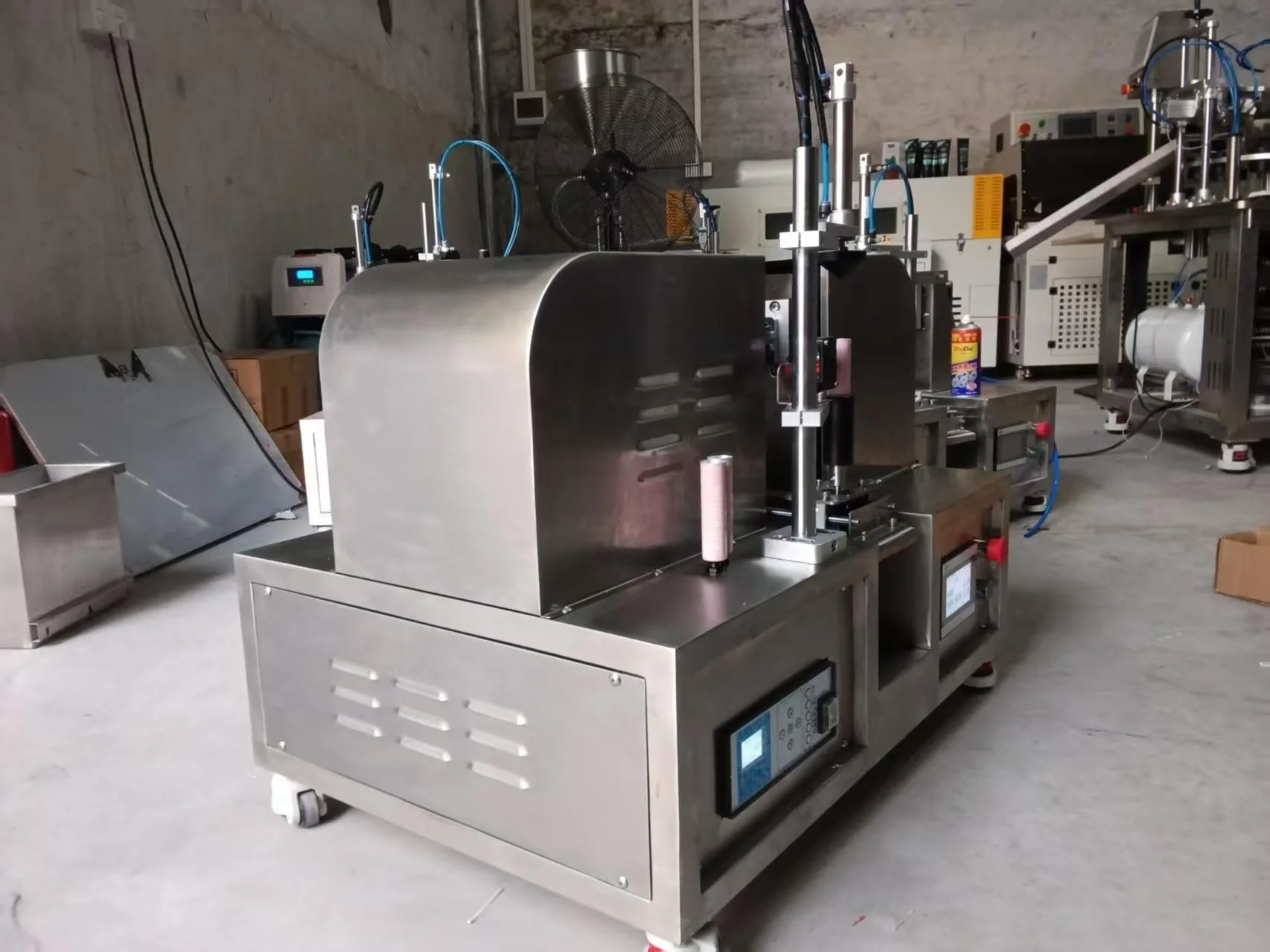
The output of a tube filling machine is quoted in tubes (or rows) per minute, but the number you can actually reach depends on your tube size, your product, and how much automation you are willing to pay for. This guide explains how to read a speed figure and pick the machine that matches your real production volume.
Why the quoted speed is a range, not a single number
Manufacturers quote a range because output is affected by product size and material. A small, low-viscosity fill runs faster than a large, thick cream; a machine that does 50 tubes/min on one product may do far fewer on another. The range tells you the envelope, not a guarantee.
Semi-automatic vs fully automatic: the real difference is labour
A semi-automatic machine loads tubes by hand, so its true output is capped by how fast an operator can feed it. The TY-001 single-station machine runs 7–13 tubes/min “depending on tube material, product nature and manual feeding speed”. A fully automatic machine loads tubes itself, so it holds a steady, higher rate with less labour.
Speed by HTKC machine
| Machine | Automation | Output |
|---|---|---|
| TY-001 single-station | Semi-auto (manual feed) | 7–13 tubes/min |
| TY-006 | Fully auto (10-station rotary) | Auto tube feed, servo piston |
| HT220 | Fully auto (12-station rotary) | 20–50 tubes/min |
| Single-dose | Fully auto (8-station rotary) | 26–32 rows/min |
| Pillow-type shrink | Automatic | 30–150 packs/min |
How to pick the right output for your volume
- Start from your daily target, not the machine’s peak. A machine that can do 50/min still only produces what your line, filling and packing can keep up with.
- Allow headroom — pick a machine that meets your volume at 70–80% of its rated speed, so it is not running flat-out all shift.
- Factor in changeovers — if you run many tube sizes, faster changeover matters more than raw speed.
- Match automation to labour cost — in regions with higher labour cost, a fully automatic machine pays for itself faster.
What to send for a matched recommendation
Give us your target daily output, tube diameter, fill volume and product type. We will recommend the machine — semi or fully automatic — that hits your volume without over-buying.
From quoted tubes/min to a real shift number
The catalogue figure is the machine running at steady state on a good tube with nothing else happening. A shift has starts, stops, changeovers and jams. Multiply the quoted figure by uptime and by performance and you get something you can plan against — that product is abbreviated OEE, and for a tube line the realistic planning band is 0.80–0.90 for uptime and 0.93–0.97 for performance.
Worked example, with the assumptions written out so you can swap in your own: a line quoted at 60 tubes/min, 85% uptime, 95% performance gives 48.5 tubes/min. Over a 450-minute net shift that is 21,800 tubes — before changeovers. Two changeovers of 40 minutes remove 80 minutes, which at 48.5/min is another 3,900 tubes. The shift is worth 17,900 tubes, not 27,000.
Now the same line on small batches, which is where most buyers get surprised:
| Batch size | Run time at 48.5/min | One 40-min changeover |
|---|---|---|
| 5,000 tubes | 103 min | 39% of run time |
| 20,000 tubes | 412 min | 10% of run time |
| 60,000 tubes | 1,237 min | 3% of run time |
This is why a fast machine is often the wrong machine for a five-product cosmetics brand. If you change product twice a shift, the changeover — not the tubes-per-minute — sets your capacity, and the money is better spent on quick-release tooling than on a higher top speed.
Where the bottleneck actually sits
A tube line runs at the speed of its slowest station, and that station is rarely the filler. On a semi-automatic platform the constraint is the operator: one pair of hands loads and removes tubes, and a comfortable rhythm is around 7–13 tubes a minute depending on tube length and how far the operator has to reach.
On an automatic line the constraint moves downstream: cartoning, leaflet insertion and case packing are usually bought for a stated speed that assumes perfect product flow, and they become the limit the first time a tube is out of round. Ask each supplier what their station does when it is starved or blocked, and whether it buffers or stops the line.
- Semi-automatic: the operator is the bottleneck. Output scales with heads and loaders, not with motor speed.
- Automatic with magazine: the magazine capacity and reload pause set the real average, not the peak.
- Full line with cartoner: buy the cartoner at 10–15% above the filler’s planning output, or it will cap you on day one.
Sizing from annual demand instead of from a catalogue
Start from the number your sales plan already contains. Take annual tubes, divide by working days, divide by net hours per shift, and you have the tubes per hour you must average. Add 25% headroom for growth and for the days when everything goes wrong.
Example: 4 million tubes a year, 250 days, one 8-hour shift with 7 net hours — that is 2,286 tubes an hour, or 38 a minute, and with headroom 48 a minute. A single-head semi-automatic machine will not do it with one operator; two units sharing one operator will, and that is the configuration most growing factories actually buy. If the number comes out above roughly 10,000 tubes a day, stop sizing semi-automatic and look at a magazine-fed line.
For how the stations around the filler are laid out once you have that figure, read planning a turnkey tube filling line. For the platforms themselves, the four machine ranges list output, fill volume and tube size side by side, and the buyer FAQ answers the output questions we get most often.
Related guides
- Semi-automatic vs fully automatic tube filling
- Fill accuracy: what ±1 g and ±1% really mean
- How to specify a tube sealing machine
- The complete guide to tube filling & sealing machines
- Complete tube filling and sealing line — turnkey project
- Tube sealing machine market: a buyer view
Tell us your target daily output and tube spec, and we will recommend the exact machine — so you pay for the capacity you actually need, not more.