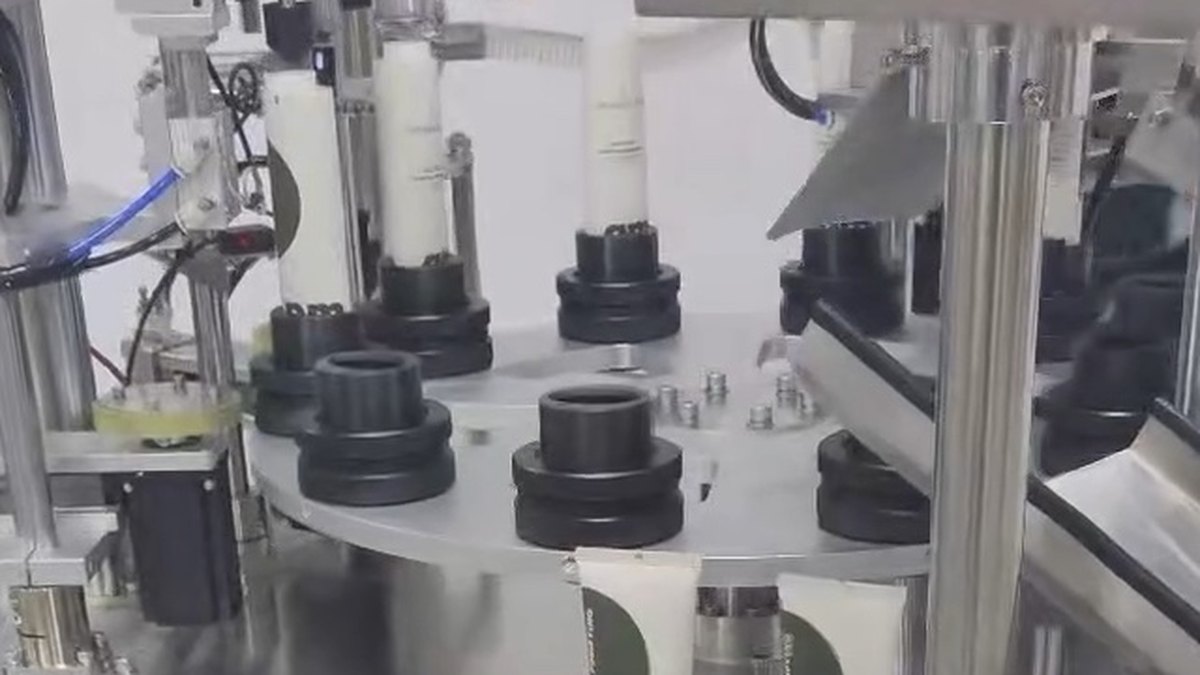
Creams, gels, ointments and toothpastes share one thing in common: they are viscous, and viscous products fill differently from thin liquids. Getting the filling right comes down to a few practical choices — the dosing system, the nozzle, and how you handle air and temperature.
Choose the right dosing system for viscous product
Thick creams meter best with a servo piston filler, which draws and dispenses a controlled volume with ±1 g accuracy across the HTKC range. For very small single-dose fills (0.2–2.5 ml) of serum or essence, a ceramic pump is used for its ±0.05 g precision and wear resistance.
Stop dripping and stringing at the nozzle
Viscous product is prone to dripping and stringing — a thin tail of product that lingers after the nozzle retracts and ends up in the sealing area. This is the most common cause of a leaking or dirty seal. Machines like the HT220 use a anti-drip, anti-stringing nozzle to prevent it, which keeps the tail zone clean for a reliable weld.
Handle air and temperature
- Air entrapment — viscous product holds air; bleed the dosing line before a run or fill volume will drift.
- Temperature — cream viscosity changes with temperature, so fill accuracy shifts between cold mornings and warm afternoons. Recalibrate when the batch or room temperature changes noticeably.
Sealing after a viscous fill
Because any product in the tail prevents a clean seal, the fill and seal stations must work together. The HTKC line keeps the fill precise and the nozzle drip-free so the ultrasonic or heat-seal station closes the tube cleanly — essential for creams that are heat-sensitive or print-critical.
Matching the dosing system to the product, not to the price list
Viscosity is the number that decides the pump, and buyers rarely have it written down. If you cannot get a cP figure from your formulator, you can still place your product in one of three practical bands by how it behaves on a spatula:
- Pours and levels within seconds (lotions, gels, toothpastes at the thin end): a peristaltic or ceramic rotary pump doses these well, and a piston is workable but oversized.
- Holds a peak but flows under its own weight (creams, toothpastes, hair masks): piston filler with a moderate bore is the standard answer, and the accuracy comes from how the piston is driven, not from the pump type.
- Stands up and does not level (ointments, petrolatum, thick gels): large-bore piston with a heated hopper, or a progressive-cavity feed. Expect to slow the cycle down — thick product needs time to enter and leave the nozzle.
Send a 1 kg sample with the temperature you fill at. A pump that is right at 20 °C can be wrong at 45 °C, and the quote changes accordingly.
Hot fill, cooling and what it does to the seal
Ointments and petrolatum products are often filled hot so they stay pumpable. Two consequences follow. First, the declared fill weight is taken at the fill temperature, and the tube will weigh less once it cools — the density change is small but it is real, and it belongs in your net-content calculation. Second, a hot product shrinks as it cools, which can pull the tail inward and stress the seal.
The practical fixes are a short cooling conveyor before sealing, or cooled sealing jaws, or a small headspace left deliberately. Which one you need depends on the tube: a PE tube tolerates a hot tail better than a thin laminated one, where the inner sealant layer can be dragged by a hot jaw. That comparison is set out in laminated vs all-plastic tubes.
Cleaning between products: the hidden cost of a viscous line
Thick product clings. A line that fills creams will spend more time cleaning than a line filling lotions, and that time is capacity you paid for and cannot use. Three design choices cut it: product contact parts that lift out without tools, a hopper with a true bottom drain rather than a side outlet, and a nozzle purge that dumps to a waste container instead of into the next tube.
Measure it before you buy: ask the supplier how long a full product change takes with one operator, from last good tube of product A to first good tube of product B. If the answer is a number in hours and nobody has timed it, that is the answer. For hygiene requirements that constrain how far you can strip the machine down, see GMP hygiene requirements for tube filling machines.
The four faults that show up on every viscous fill
- Tailing. Product strings from the nozzle to the tube. Usually too fast a retract, too large a nozzle bore, or a product that needs a suck-back.
- Air pockets. The tube weighs right but is short by volume. Product was aerated in the hopper, or the feed cannot keep up at the fill speed.
- Weight drift through the shift. Temperature and hopper level change the effective dose. Log both alongside the weights and the cause becomes obvious.
- Product in the seal area. A smear of cream on the inside of the tail will not weld. That is a filling problem that only shows up as a sealing defect, which is why seal inspection and fill control have to be run together.
If your product is a cream or ointment and the container choice is still open, tube vs bottle vs jar explains how the container decides the machine before the product does. Sample runs on your own product are quoted through the contact page.
If you have to write viscosity, net content or fill weight into a specification, the definitions used across this site are in the tube filling glossary.
Related guides
- Fill accuracy: what ±1 g and ±1% really mean
- Troubleshooting common sealing machine faults
- Ultrasonic vs heat sealing — which process your tube needs
- The complete guide to tube filling & sealing machines
- Turnkey tube filling line from specification to shipment
- Tube sealing machine market: a buyer view
Filling creams, gels or ointments? Send us your product viscosity and fill volume, and we will recommend the dosing system and nozzle that keep your fill precise and your seals clean.