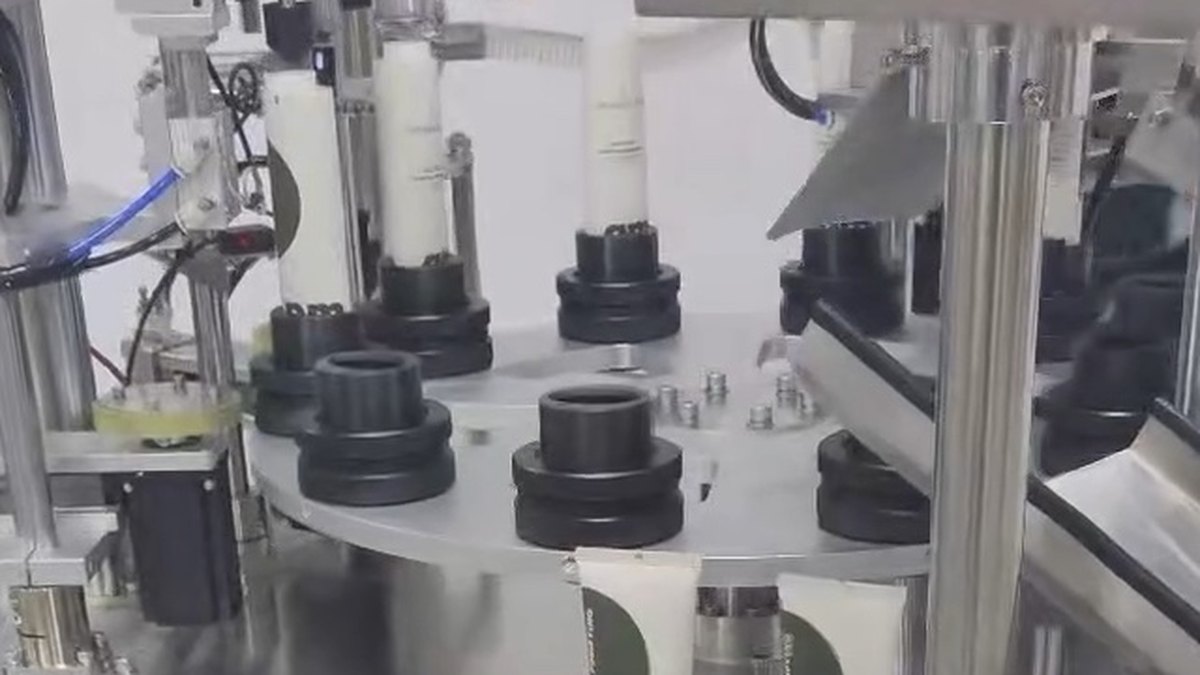
A tube filling machine rarely works alone. In a real production plant, it sits in the middle of a line: tubes are loaded, filled and sealed, then coded, boxed, and prepared for shipping. If you are planning a new production line — or upgrading an existing one — understanding the full line and how the pieces connect will help you avoid bottlenecks and buy the right equipment the first time.
The mistake most buyers make is treating the filler as the whole project and everything else as an accessory. In practice the filler is rarely the constraint: on most lines the tube loader at the front and the packing station at the back decide the real output. This guide walks the five stages, then shows how to size each one so nothing is oversized and nothing starves.
The Stages of a Typical Tube Filling Line
1. Tube Loading and Orientation
Tubes must be presented to the filling station the right way up and, for printed tubes, oriented so the artwork aligns correctly. On semi-automatic lines this is done by an operator; on automatic lines, a tube loader and orienting device feeds tubes automatically. This stage sets the pace for the whole line, so its reliability matters.
The magazine capacity on an automatic loader is worth checking before you sign: a small magazine needs refilling every 15–20 minutes, which quietly turns an automatic machine back into a semi-automatic one because someone has to stand there. Ask how many tubes it holds and how the refill is done — top-loading while running is normal, stopping the line to reload is not.
Orientation matters more than buyers expect. Tubes with an off-centre shoulder or an oval cap need a mechanical orienter; getting this wrong shows up as crooked seals that pass inspection but look wrong on a shelf. If you print on the tube body rather than the shoulder, confirm the registration system reads your mark position before the machine is built.
2. Filling
The core step. Dosing accuracy is what buyers care most about — servo piston systems deliver fill accuracy around ±1 g, while precision ceramic-pump systems for small volumes can reach tolerances in the range of ±0.05 g. The dosing technology should be matched to your product viscosity and fill volume.
Three variables decide whether the filler keeps up with the rest of the line: the number of filling stations, the fill volume, and how fast the product flows. A single-station machine filling a 100 ml cream is slower than the same machine filling a 15 ml gel, because the piston has further to travel and the product resists moving. This is why quoted output is always a range and why you should test with your own product, not water.
For multi-station fillers, check whether the stations dose simultaneously or sequentially — it changes the effective cycle time. And if you plan to run two products with very different viscosities on the same line, ask whether the hopper and dosing system can be swapped or whether you need a second machine.
3. Sealing
Heat sealing for plastic and laminated tubes, folding for aluminium tubes, or ultrasonic sealing for clean, consistent bonds. The sealing method is dictated by your tube material — confirm this before you design the line.
Ultrasonic sealing has two practical advantages on a production line: there is no warm-up, so the machine is ready at the start of the shift, and the weld does not scorch the print on laminated shoulders — a failure mode that costs heat-sealers a run of rejected tubes every time the temperature drifts. Heat sealing remains perfectly adequate on all-plastic tubes, where there is no print to protect.
Whatever the method, the trimming station that follows is where most line stoppages originate. A blunt blade leaves a ragged tail; a mis-set blade cuts into the seal. Budget for blades as a consumable and keep a spare set on site — it is a low-cost part that stops the whole line when it fails.
4. Coding and Marking
Batch number, expiry date, and production date are printed on the tube, usually by a hot-stamp, inkjet, or laser coder integrated after sealing. For pharmaceutical products this coding is mandatory and must be legible and permanent.
Placement is a design decision, not an afterthought. On a laminated tube the code usually goes on the crimped tail; on an aluminium tube it goes on the fold. If the code has to sit on the tube body instead, the coder has to be positioned before the tube is oriented away from the print area — which means specifying it when the line is laid out, not adding it later.
Hot-stamp is cheapest and works on most laminated tubes; inkjet is more flexible for variable data but needs ink handling; laser gives a permanent mark with no consumables but costs more up front. For regulated markets, confirm that the chosen method produces a mark that survives handling and shipping, because an illegible expiry date is a compliance failure regardless of how good the seal is.
5. Final Inspection and Packing
Finished tubes are checked, then packed into cartons — either by hand or with a cartoning machine. For higher volumes, end-of-line automation (cartoning, case packing) removes the labour bottleneck.
This is the stage buyers most often leave out of the budget, and the one that caps the line. Two people packing by hand can handle a semi-automatic machine comfortably; the same two people cannot keep up with a fully automatic filler running 30 tubes a minute, so the machine sits idle while cartons are filled. If you are automating filling, plan the packing step at the same time or accept that the line will run below its rated speed.
A simple inspection routine at this station catches most problems before they ship: check one tube per batch for seal integrity and code legibility, and weigh a sample to confirm the fill is still on target. Both take under a minute and catch the failures that are invisible on a moving line.
Semi-Automatic vs Fully Automatic Lines
- Semi-automatic — lower initial cost, flexible for multiple tube sizes, ideal for smaller batches and startups. Output is limited by operator speed.
- Fully automatic — higher throughput and consistency, lower labour cost per unit, ideal for established brands running one or two tube sizes at volume.
The choice is not really about budget — it is about the number of tubes you need per day and how often you change tube size. A semi-automatic machine that runs one operator at 7–13 tubes a minute covers roughly 4,000 tubes in an eight-hour shift. A fully automatic machine at 20–50 tubes a minute covers 10,000 to 25,000 on the same shift, with one person supervising instead of loading.
| Line configuration | Typical daily output | Labour per shift | Fits |
|---|---|---|---|
| Semi-automatic filler + hand packing | 3,000–5,000 tubes | 1 loading + 1–2 packing | Startups, pilot batches, many small orders |
| Semi-automatic + cartoner | 4,000–8,000 tubes | 1 loading + 1 supervising | Growing brands, contract packers |
| Fully automatic filler + cartoner | 10,000–25,000 tubes | 1 supervising | Established brands, one or two tube sizes at volume |
| Fully automatic + case packer | 20,000+ tubes | 1 supervising + 1 line assistant | High-volume single-product lines |
The crossover sits around 8,000–10,000 tubes a day. Below it, a semi-automatic machine plus one operator is cheaper to buy and cheaper to run. Above it, the labour saving from automation generally repays the price difference within a year or two — and the consistency gain (every tube sealed the same way) is worth something the spreadsheet does not capture.
How to Plan Your Line Without Overbuying
- Start from output, not from the machine — define your target tubes per day, then size each stage to that number.
- Identify the bottleneck first — usually loading or packing, not filling; automating the wrong stage wastes money.
- Leave room to grow — buy a filling machine that can be upgraded or matched with automation later, rather than replacing it.
- Work with one supplier who understands the whole line — mixing unrelated machines creates integration and support headaches.
Size each stage the same way: daily output = rated speed × 60 × productive hours × 0.85. The 0.85 covers changeovers, cleaning, breaks and minor stoppages. Size every stage to the same number and the line runs balanced; size only the filler and the slowest stage sets your real output.
Work through it once on paper before you request quotes. Take your target daily output, divide by the number of shifts and by the 0.85 efficiency factor, and you have the tubes-per-minute every stage must sustain. If the filler can do it but the packing station cannot, the extra money spent on a faster filler bought nothing.
Frequently Asked Questions
Do I need a fully automatic line to be competitive?
No. Below roughly 8,000 tubes a day, a semi-automatic machine with one operator is the cheaper option on both purchase and running cost, and it handles frequent tube-size changes better than an automatic line. Automation pays when volume is stable and high, not because it is more advanced.
What is the bottleneck on a typical tube filling line?
Usually tube loading at the front or manual packing at the back — not the filler itself. Buyers routinely overspend on a faster filler while the line still stalls on cartons. Measure the time each stage actually takes before deciding what to upgrade.
Can I add automation to a line I already own?
Often yes, if the filler was specified with that in mind — a tube loader and a cartoner can usually be added later around an existing machine. What is hard to retrofit is sealing technology: a heat sealer cannot become an ultrasonic sealer, so get that decision right at the start.
How much floor space does a complete line need?
A semi-automatic filler with hand packing fits in a small room. A fully automatic line with loader, filler, coder and cartoner needs a straight run several metres long plus access on both sides for cleaning and maintenance. Send your available footprint before the layout is drawn — retrofitting a line into a room that is too narrow is far more expensive than planning around it.
Related guides: Output speed guide · Semi vs fully automatic · Cost factors · The complete guide · The market, from a buyer side
Planning a complete tube filling line?
Tell us your target daily output and tube sizes — we’ll map the line and quote the right equipment.