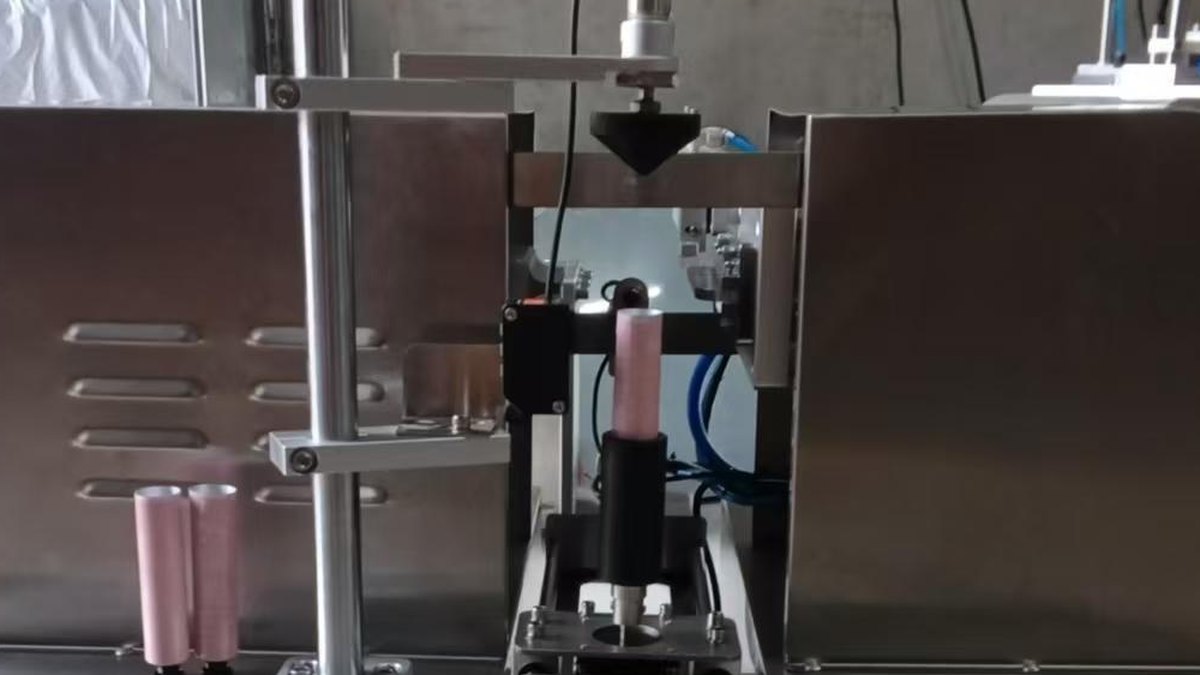
A tube sealing machine closes the open tail of a tube by one of two very different physical processes: ultrasonic sealing or heat sealing. They look similar on the shop floor, but they are not interchangeable — each works on a different tube material, and using the wrong one means a tail that leaks, scorched print, or a machine that simply will not close the tube.
The two processes, side by side
Heat sealing presses a hot jaw against the tube wall until the plastic melts and welds shut, then holds it under pressure while it cools. It is the standard method for plastic tubes (PE) and many laminated/composite tubes.
Ultrasonic sealing uses high-frequency vibration (typically 20 kHz) to generate friction heat inside the material itself, welding the tube shut without any external hot element. It also works on plastic and laminated tubes.
A third operation — folding/crimping — is for aluminium (metal) tubes. The tail is heated, folded over two or three times and crimped flat. It is not welding at all, and a folding machine cannot weld, just as a welding machine cannot fold.
Where the heat comes from — and why that decides everything
The whole difference comes down to one question: is the heat applied from outside, or generated inside the material?
A heat jaw puts energy in from the outside, so heat has to travel through the tube wall to reach the inner sealing layer. That takes time, and it also heats everything in between — including the printed surface. An ultrasonic horn couples vibration into the material, and the friction between the polymer layers at the joint converts it to heat exactly where the weld needs to be.
That single mechanism explains three practical consequences: why ultrasonic needs no warm-up, why it is gentler on print, and why it is fussier about the tube’s inner layer.
| Aspect | Heat sealing | Ultrasonic sealing |
|---|---|---|
| Warm-up | Needs time to reach jaw temperature | Ready immediately |
| Heat path | Outside in, through the wall | Inside the joint itself |
| Effect on print | Risk of scorching on thin or heat-sensitive film | Low — print stays crisp |
| Seal appearance | Visible jaw imprint, slightly wider weld zone | Smooth, narrow, cosmetic-grade tail |
| Main wear item | Heater, thermocouple, jaw facing | Horn and anvil |
| Material constraint | Needs a thermoplastic sealant layer | Also needs a thermoplastic layer, plus enough stiffness in the tail |
When to choose ultrasonic sealing
Ultrasonic sealing is clean, fast and energy-efficient. Because the heat is generated inside the material, there is no long warm-up and far less risk of scorching the printed surface — the print stays crisp. The tail is smooth and cosmetic-grade, which matters for premium creams, gels and toothpaste.
It is the right choice when you want a consistent, attractive seal on plastic or laminated tubes at moderate to high output. It is also the practical answer when the print runs close to the tail: with a hot jaw, a design that sits near the weld zone is a permanent scorch risk, and the artwork has to be redrawn. With ultrasonic, that constraint largely goes away.
When to choose heat sealing
Heat sealing suits thicker plastic tube walls and certain laminated film structures where a hot jaw gives a dependable weld. It is often the simpler, lower-cost station. The trade-off is warm-up time and the need for careful temperature control to avoid scorching the print on thin or heat-sensitive film.
Heat also forgives more variation in the tube wall. If your tube supplier changes and the wall thickness or inner-layer formulation drifts slightly, a hot jaw with a settable dwell is usually easier to re-tune than an ultrasonic stack.
How each process maps to HTKC machines
- Ultrasonic — TY-001 semi-automatic (7–13 tubes/min, 15–50 mm diameter, 50–260 mm length) and TY-006 fully automatic (10-station rotary).
- Heat sealing — HT220 fully automatic soft-tube machine, 12-station rotary, 16–50 mm diameter, 20–50 tubes/min.
- Folding/crimping — AT300-A for aluminium and metal tubes.
A quick decision table
| Tube material | Sealing process | HTKC machine |
|---|---|---|
| Plastic (PE) | Heat or ultrasonic | TY-001 / TY-006 / HT220 |
| Laminated / composite | Heat or ultrasonic | TY-001 / TY-006 / HT220 |
| Aluminium (metal) | Folding / crimping | AT300-A |
Not sure which one your tube needs? Read our guide on how to specify a tube sealing machine for the five numbers to prepare before you ask for a quote, or compare tube types in plastic, laminated or aluminium tube.
What the choice actually costs you over a year
Buyers usually compare the two stations by purchase price. The more useful comparison is the cost of keeping each one running, because the two processes wear differently:
| Cost line | Heat sealing | Ultrasonic sealing |
|---|---|---|
| Energy in use | Continuous draw to hold jaw temperature, including idle time | Draws mainly when actually welding |
| Wear parts | Heater element, thermocouple, jaw coating | Horn tip and anvil insert |
| Rejects | Scorched or over-wide welds on thin film; drift when ambient changes | Incomplete welds when the stack is out of tune or the tube tail is too stiff |
| Operator skill | Temperature and dwell setting — teachable in a shift | Horn tuning and amplitude — needs a trained technician |
The pattern to watch is idle time. A heat-sealed line that sits between batches still holds its jaws hot; an ultrasonic stack does not. At high utilisation the gap narrows, at low utilisation it widens. The broader cost structure is broken down in what drives tube filling machine cost.
How to tell whether the seal is actually good
Whichever process you pick, the seal is only as good as what you can measure. Three checks cover most of the risk:
- Visual: the weld line should be continuous, with no channel, bubble or unfused strip. A seal that looks fine but has a thin channel will leak slowly, not immediately.
- Pressure / leak: squeeze or pressurise a sample from each batch and watch for product at the tail.
- Peel or burst: pull the tail apart or pressurise until it fails, and check that failure happens in the film rather than along the weld.
The full procedure, sample sizes and what each failure mode points to are set out in seal quality inspection and leak testing. If a seal is already failing in production, work through tube sealing machine troubleshooting in order rather than adjusting settings at random.
Aluminium is a different operation, not a third option
A common and expensive misunderstanding: aluminium tubes are not sealed by either welding process. The tail is heated, folded two or three times and crimped flat. No weld is formed, so there is no sealing layer to fuse.
This matters at the buying stage. If your artwork or brand plan calls for aluminium, an ultrasonic or heat machine will not do the job no matter how it is configured. See aluminium tube folding vs welding for what the folding machine actually does.
Frequently asked questions
Can one machine do both ultrasonic and heat sealing?
In practice, no. The sealing station is built around one process — a horn and anvil, or a heated jaw. Some platforms can be reconfigured at the factory, but it is a machine-level decision, not a setting you change per batch.
Which is faster?
Speed comes mainly from the platform, not the sealing method. A 10-station ultrasonic rotary and a 12-station heat rotary both run continuous cycles; the station count and tube size set the rate. Compare machines at the same station count.
Why does my ultrasonic seal look fine but still leak?
Usually an incomplete weld: the horn is out of tune, amplitude is too low, or the tube tail is too stiff for the energy applied. A visual check will not catch it — only a leak or peel test will.
Does ultrasonic damage the product inside?
The heat is confined to the weld zone, so the product itself is not heated the way it would be by a hot jaw. This is one reason ultrasonic is preferred for heat-sensitive creams and gels.
What if I change tube supplier later?
Check the inner sealant layer first. Both processes need a thermoplastic layer, and a supplier change that alters it can invalidate a seal setting that worked for years.
Related guides
- Plastic, laminated or aluminium tube — choosing the material
- Aluminium tube folding vs welding explained
- The complete guide to tube filling & sealing machines
- Seal quality inspection and leak testing
- How to specify a tube sealing machine
- Machine output: choosing the right speed
- Complete tube filling and sealing line — turnkey
Send us your tube material, diameter and fill volume, and we will recommend the exact sealing process and machine for your product — with a factory-direct quote.