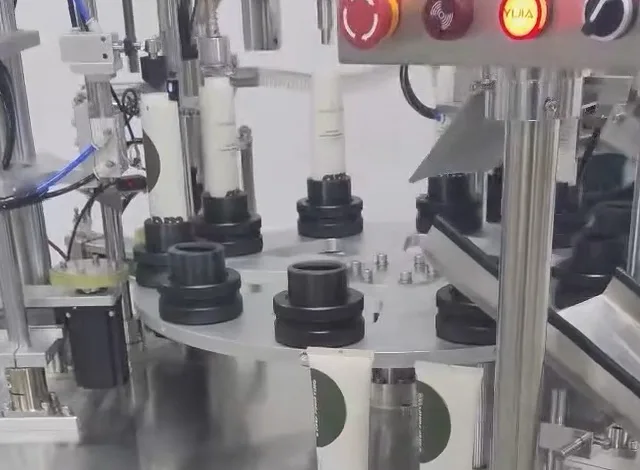
For cosmetics, pharmaceutical, and personal-care manufacturers, hygiene is not an option — it is the difference between a product that clears regulatory review and one that is rejected at the border. If you are evaluating a tube filling and sealing machine for creams, ointments, gels, toothpaste, or medicinal pastes, understanding the material and design features that support Good Manufacturing Practice (GMP) compliance will save you from expensive rework later. This guide explains the hygiene-critical features to look for, how to verify them at acceptance, and how HTKC machines are built around them.
Why hygiene matters for tube filling
Tubes are a direct-contact package. The product touches the filling nozzle, the dosing system, and the inside of the tube body, and it remains there until the consumer uses it. Any contamination introduced during filling — lubricant, rust, residue from a previous batch, or microbial growth in a crevice — sits inside that sealed tube for months. This is why regulators in pharmaceutical and cosmetic markets place so much emphasis on the materials and cleanability of the filling line.
The practical consequence is that hygiene is not a single attribute you can specify once. It is the sum of four things: what the product touches, how completely those surfaces can be cleaned, what the machine does to keep contamination out between cleaning cycles, and what paperwork you can produce to prove all three.
The four hygiene-critical features to check
1. Food-grade contact materials
Every component that touches product should be 304 or 316 stainless steel, or an approved food-grade polymer. 316 offers better resistance to chlorides and aggressive formulations, making it the safer choice for medicated creams and salt-containing products. HTKC tube filling machines use stainless steel for the hopper, dosing system, and product-contact nozzles, which resists corrosion and does not leach into the product.
The distinction between 304 and 316 is not marketing. Chloride attack shows up as pitting on a polished surface — small dark pits that hold product and cannot be cleaned out by wiping. If your formulation contains saline, mineral salts, or an aggressive active, ask specifically for 316 on the wetted parts and get the material certificate with the machine, not after a complaint.
2. Drip-free, self-cleaning nozzles
A dripping nozzle is a hygiene problem as much as a waste problem: product accumulates at the tip, dries, and becomes a contamination and cross-batch risk. Look for anti-drip nozzle design with a clean shut-off. The HT220 fully automatic soft-tube filling and sealing machine is built with an anti-drip nozzle that cuts off cleanly at the end of each dose, keeping the sealing area clean and reducing product waste.
Check this at the demonstration, not on the datasheet. Run the machine for a few hundred tubes and look at the nozzle tip between doses. A well-set anti-drip nozzle stays visually dry; a marginal one shows a bead that grows and drops every few cycles. That bead is the difference between a clean seam and a rejected tube, and it is a setup issue as often as a design issue.
3. Easy disassembly and cleaning (CIP-friendly)
GMP requires that equipment can be cleaned between batches without leaving dead zones where product can hide. Tool-free removal of the hopper, dosing parts, and nozzles matters more in daily operation than almost any other feature. Machines that need tools and minutes to strip down get cleaned less often — and that is where contamination creeps in.
There is a second point behind the first. Cleanability is not only about how fast a part comes off; it is about whether the geometry can be cleaned at all. A welded corner, an internal thread, a step where two diameters meet — each of these is a place where a brush cannot reach. When you look at the machine, look for radiused internal corners, sanitary clamp fittings rather than threaded joints on product lines, and drain paths that do not rely on the operator tilting the machine.
4. Enclosed or purged critical zones
For higher-risk products, consider whether the fill zone can be enclosed, purged, or operated under positive pressure. This is more relevant for pharmaceutical lines than for basic cosmetics, but the option to add guarding and air filtration is worth confirming with the manufacturer before purchase.
Ask the question early, because it changes the machine frame, not just an accessory. A line designed for a later enclosure has the space and the mounting points; a line not designed for it usually cannot be retrofitted economically.
Matching hygiene level to your product
Not every product needs a full cleanroom line. Match the machine to your risk profile — and be honest about which row you are in, because over-specifying costs money and under-specifying costs a market.
| Product group | Risk | Contact material | Typical requirement |
|---|---|---|---|
| Cosmetics / personal care | Low–moderate | 304 | Anti-drip nozzle, easy disassembly, written cleaning routine |
| Toothpaste / OTC pastes | Moderate | 304 (316 if salted) | Cleanable dosing, batch records, seal verification |
| Pharmaceutical / medicated ointments | Higher | 316 | Fully cleanable dosing, documented SOPs, ideally enclosed fill zone |
| Single-dose / sterile | Highest | 316 | Cleanroom integration and validation support — discuss directly |
Documentation is half of compliance
A clean machine with no paperwork is an audit finding waiting to happen. What auditors and your own quality team will ask for is a small, boring set:
- Material certificates for wetted parts — the mill certificate identifying the grade, not a statement that it is “stainless steel”.
- A cleaning procedure that names the chemistry and the contact time — not just “clean after each batch”.
- An illustrated parts list so a seal change can be verified and recorded.
- A maintenance and cleaning log that is actually filled in — the record is the evidence, not the intention.
If you export to a regulated market, ask additionally whether the supplier can support a validation or qualification package, and get the answer in writing before the order. It is much easier to negotiate at quotation than after installation.
What to check at acceptance
- Strip the product path yourself. Remove the hopper, dosing parts and nozzle with the tools you will actually have on the shop floor. If it needs a special tool, that is a finding.
- Look inside with a torch. Check every internal corner for a weld bead, a thread, or a step. Those are the places cleaning will fail.
- Run the anti-drip check. A few hundred tubes, then look at the tip between doses.
- Verify the grade, not the claim. Match the certificate to the parts. On a mixed machine, confirm which parts are 316 and which are 304.
- Time the cleaning. Do a full between-batch clean once, with a stopwatch. That number is the real cost of your changeover, and it belongs in your SOP.
- Confirm the drain path. Water should leave the machine without being tipped or sponged out.
Four misconceptions worth correcting
“Stainless steel is stainless.” 304 pits in chloride environments. If your product carries salt, the grade is a functional decision, not a cosmetic one.
“CIP means automatic cleaning.” CIP is a design property — a machine that can be cleaned in place. It still needs a validated procedure, correct chemistry, contact time and a verification step.
“Hygiene is the machine’s job.” Most hygiene failures we see are procedural: a cleaning step skipped on a busy shift, a solvent substituted, a log signed without the work done. The machine can only make the right procedure easy.
“A bigger machine is a cleaner machine.” Size has nothing to do with it. A small machine with tool-free disassembly and radiused corners beats a large one with threaded joints every time.
Questions to ask your supplier
Before you commit, confirm these points in writing:
- Which components are 304 vs 316 stainless steel, and which are polymer?
- Can the hopper and dosing system be removed without tools for cleaning?
- Does the nozzle have a documented anti-drip mechanism?
- Are material certificates (e.g. food-grade, FDA-compliant where applicable) available for contact parts?
- What is the documented cleaning procedure, and does it come with the machine?
- Can the fill zone be enclosed or purged later, and what does that change on the frame?
FAQ
Is a GMP machine more expensive?
Usually somewhat, mainly through material grade, surface finish and documentation. The comparison that matters is not machine price but the cost of a rejected shipment or a failed audit — both of which are far larger than the delta on the quotation.
Do I need 316 if I make cosmetics?
Usually not, unless the formula is saline, acidic or contains an aggressive active. For a standard cream or lotion, 304 with good cleanability is the normal choice. Decide on the formulation, not on the label.
How do I prove the machine is clean?
A written procedure, a record that it was followed, and a verification step your quality team defines — visual inspection after cleaning is the minimum, and many manufacturers add a rinse or swab check. The machine enables this; the procedure proves it.
Does the machine come with a cleaning SOP?
Ask for it explicitly at quotation stage. A generic maintenance sheet is not a cleaning SOP; you want the chemistry, the disassembly sequence and the contact times for your product.
Related guides: How to specify a tube sealing machine · Filling creams & ointments · Single-dose tube filling · Maintenance checklist · The complete guide
Need a hygiene-compliant tube filling line?
Tell us your product and filling volume — we’ll recommend a machine built for GMP-friendly operation.