From US$1,000 · FOB Guangzhou
Final price depends on tube or pouch size, material and output. Send your sample specification for an exact quote.
Two Formulas, One Tube, One Machine
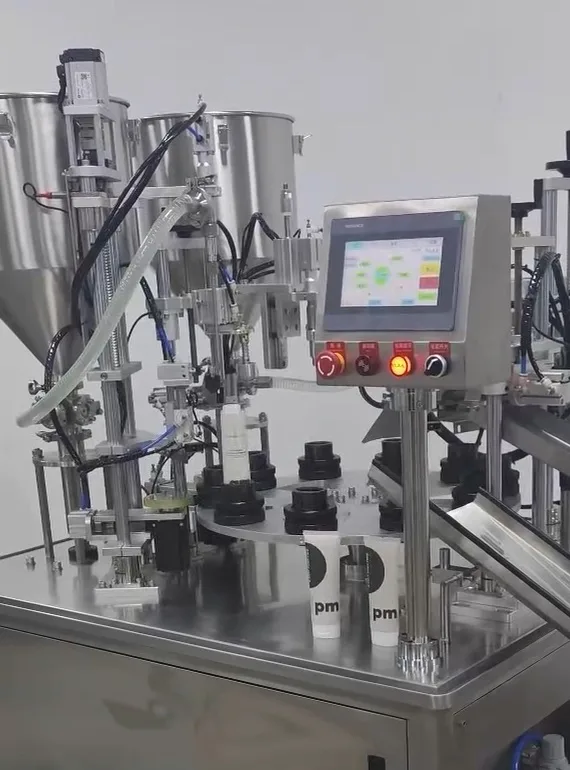
This fully automatic mother-and-child tube filling and sealing machine combines two servo piston fillers, ultrasonic sealing, automatic tail trimming and finished-product ejection on one rotary platform. It is built for plastic tubes and aluminium-plastic laminated tubes in the cosmetics, pharmaceutical, food and chemical industries, and it is designed specifically for dual-chamber tubes — the kind where an inner barrel and an outer barrel hold two different formulas, or two colours of the same formula.
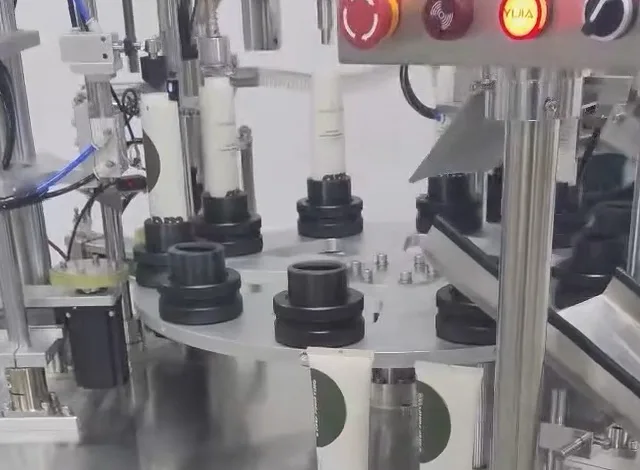
Empty tubes are drawn from the tube magazine, oriented and placed onto the rotary fixture by the automatic tube feeder — no manual loading. From there the machine takes over: the outer barrel is dosed at the first filling station, the tube is aligned by a photoelectric colour-mark sensor, the inner barrel is dosed at the second station, and the tail is welded by an ultrasonic sealing head. The excess tail is trimmed automatically and the finished tube is ejected to the discharge chute.
Control is handled by a PLC with a 7-inch touch screen. Filling volume, machine speed, output counting and fault messages are all managed from that one screen, and the machine is interlocked so that no product is dispensed when no tube is present.
What Is a Mother-and-Child Tube?
A mother-and-child tube — also called a dual-chamber, double-barrel or bi-chamber tube — holds two products inside one tube body. The mother (outer) chamber surrounds the child (inner) chamber, and both are squeezed out through the same nozzle. Depending on the tube head design the two pastes come out side by side as a stripe, or mix only as they leave the orifice.
That construction is what makes a normal single-nozzle filler unsuitable: the two chambers must be dosed separately, in the right order, without cross-contamination. This machine solves it with two independent servo piston filling stations — outer barrel first, then the inner barrel — before a single ultrasonic seal closes the tube.
Built for Dual-Chamber Production
Seven Steps from Empty Tube to Sealed Product
Machine Parameters
| Machine type | Fully automatic mother-and-child (dual-chamber) tube filling and sealing machine |
| Packing material | Plastic tubes and aluminium-plastic laminated tubes |
| Fill volume | 10 – 150 ml per barrel |
| Suitable product | Creams, gels, ointments and paste products |
| Filling method | Servo piston filling |
| Filling accuracy | Approx. ±1 g |
| Control system | PLC + 7-inch touch screen HMI |
| Output | Approx. 10 – 15 tubes / min |
| Air supply | 0.6 – 0.8 MPa |
| Power | Approx. 5 kW (AC 220 V, 50 Hz) |
| Sealing height (tube length) | 60 – 230 mm |
| Sealing diameter | 13 – 50 mm |
| Overall dimensions | Approx. L 1500 × W 1300 × H 1800 mm |
| Machine weight | Approx. 550 kg |
Dimensions and weight are for reference; the delivered machine prevails. Output depends on tube size, product viscosity and the operator’s loading speed.
Components & Brands
| No. | Component | Qty | Brand |
|---|---|---|---|
| 1 | PLC programmable controller | 1 | HCFA |
| 2 | Touch screen | 7″ | HCFA |
| 3 | Photoelectric sensor | — | Jiazun / Jingjiake |
| 4 | Pneumatic components | — | AirTAC / Chelic |
| 5 | Servo motor | — | HCFA |
| 6 | Three-phase motor | — | Domestic brand |
| 7 | Stepper motor | — | JMC |
| 8 | Variable frequency drive | — | Yuanxin |
| 9 | Relays & air circuit breakers | — | CHINT |
| 10 | Power supply | — | MEAN WELL |
| 11 | Ultrasonic system | 1 set | In-house developed |
Tube Range & Materials
The machine handles single-layer plastic tubes and laminated tubes with an aluminium or multi-layer barrier — PE, PP and aluminium-plastic composite tubes in both cases. Tube diameter and length are changed by swapping the fixture and sealing mould; custom moulds can be developed for non-standard tube heads or chamber layouts.
Industries & Products
Product Photos
Mother-and-Child Tube Filling Line in Operation
What Makes This Machine Different
- Dual-chamber capability in one machine — two filling stations and two hoppers on a single frame. You get a bi-colour or two-component tube without buying a second filling line or moving tubes between machines.
- Servo dosing, repeatable results — servo piston fillers hold about ±1 g, so the declared net weight stays within tolerance and product giveaway is kept low.
- Ultrasonic sealing without consumables — no glue, no hot air, no heater bands — just a clean weld with a consistent decorative crimp, which also keeps maintenance simple.
- Continuous automatic cycle — automatic tube feeding, registration, dosing, sealing and trimming run in one continuous cycle, so one operator can supervise the line after a short training session.
- Branded control components — HCFA PLC, servo and HMI, AirTAC pneumatics, CHINT switchgear and MEAN WELL power supplies — parts that are easy to source locally when service is needed.
Where it fits in a line
This is a complete fill-and-seal cell: empty tubes in at one end, sealed dual-chamber tubes out at the other. Feeding, registration, two fillers, sealing and trimming all happen inside the same footprint, which is why the line around it can be short — and why the numbers on the nameplate are not comparable with a semi-automatic station’s.
| Stage | What happens | What it needs from you |
|---|---|---|
| Upstream | Empty tubes are loaded into the magazine in bulk, no orientation needed. Two products go into two hoppers. | Tube cartons stored flat and dry, two product batches, and a way to reach the hoppers at 1.8 m |
| This machine | Automatic tube feed → eye-mark registration → two servo piston fillers → ultrasonic seal → tail trim → discharge. The two barrels are dosed independently, then sealed together. | A recipe per product: fill volume for each barrel, the ratio between them, and the seal parameters |
| Downstream | Sealed dual-chamber tubes leave at the discharge side. From there it is cartoning — by hand, or by a cartoner if you have one. | About a metre of clear space at the discharge side |
| Optional | Coding at the sealing station; a heated or jacketed hopper where the product has to stay warm to flow. | Product viscosity at filling temperature, not at room temperature |
Installation: what the site has to provide
- Power — AC 220 V, 50 Hz, approx. 5 kW.
- Air — 0.6–0.8 MPa. Higher than a sealing-only station needs, because feeding, filling and sealing are all pneumatic or servo-driven here.
- Floor — Approx. 1500 × 1300 × 1800 mm, 550 kg. It does not need anchoring, but it does need to sit level — a machine out of level will not seat tubes reliably.
- Height — The machine stands 1.8 m and loads from above. Leave working height for a step or a small platform; lifting tube cartons over shoulder height is how operators get hurt.
Changeover: what changes with a new tube or a new product
- Fill volume, 10–150 ml per barrel — servo stroke, saved as a recipe. No mechanical change.
- Ratio between the two barrels — a separate parameter from total volume — this is the number that defines a mother-and-child product, and it is stored per SKU.
- Tube size, Ø13–50 mm × 60–230 mm — change parts, quoted against the tube drawing.
- Product viscosity — dosing speed and suck-back are trimmed once per product. A product that changes with ambient temperature should be run at a stable temperature, not re-tuned twice a day.
The 10–15 tubes per minute already includes the feeding and filling that a semi-automatic setup does by hand, so do not compare the two figures directly: one is a cell rate, the other a station rate. This guide explains how to put both on the same basis, and this one covers what different product types demand from the filler.
Troubleshooting: what the symptom tells you
On a dual-chamber machine the fault that matters most is a mismatch between the two barrels, because the ratio is the product. These are the symptoms that show up on the mother-and-child platform and what each one points to.
A dual-chamber fault is nearly always a dosing fault rather than a sealing fault. Measure both barrels separately before adjusting anything on the sealing head.
Questions buyers ask before ordering
Which product goes in which chamber?
How is a mother-and-child tube different from a standard tube?
What output and accuracy does it reach?
What tube sizes does it run?
Is tube loading really automatic?
What does the machine need from the factory?
Related guides
- Plastic, laminated or aluminium tube — choosing the material
- Machine output: picking the right speed for your volume
- Semi-automatic vs fully automatic tube filling
- Building a complete turnkey filling line
- Energy & maintenance cost
Request a Quotation
Send us your tube diameter, tube length, chamber layout and required fill volume, and we will confirm the right configuration — including custom fixtures and a sealing mould for your tube head. Sample tubes and product testing are welcome before you order.
xiexuetao@htkcai.com