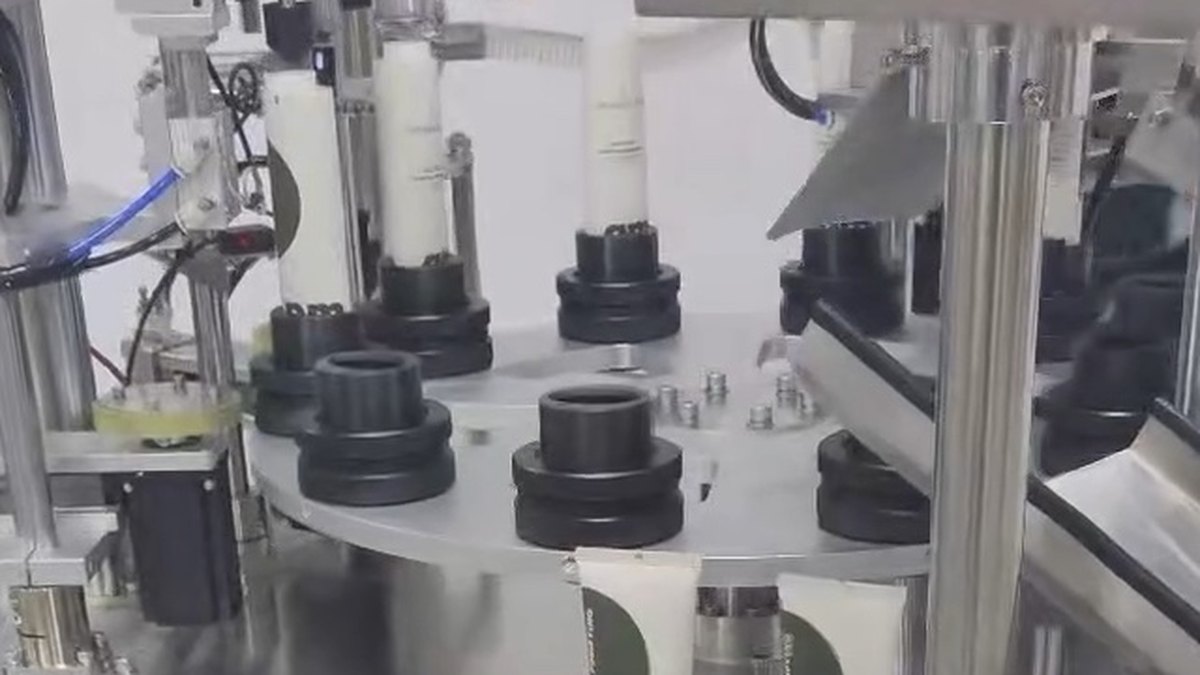
Fill accuracy is how close the dispensed volume of product comes to the target on every single tube. On a spec sheet it looks like ±1 g or ±1%, but what that number actually means — and how much it will cost you in product giveaway — depends on how the filling is measured and what you are filling.
What the ± number really means
A spec of ±1 g means the actual fill on any tube should land within 1 gram of the target. On a 100 g tube that is ±1%, but on a 15 g tube the same ±1 g is ±6.7% — which is why accuracy is quoted as a percentage for small fills and as a gram figure for larger ones. Always ask which unit the figure is in, because the two are not interchangeable.
How filling accuracy is achieved
Accuracy comes from the dosing system, not the tube. The three common systems on tube fillers:
- Servo piston — a motor-driven piston draws and dispenses a precise volume; typically ±1 g across the range. Used on HTKC’s TY-001, TY-006, HT220 and AT300-A.
- Ceramic pump — a ceramic rotary pump for very small, consistent doses; ±0.05 g. Used on the single-dose machine for 0.2–2.5 ml fills.
- Pneumatic piston — simpler, air-driven, slightly less precise but lower cost; available as an option on some models.
What affects accuracy in practice
- Product viscosity — thin liquids meter differently from thick creams; the HT220 quotes ±1% with a servo piston, and output is noted as “affected by product size and material”.
- Fill volume — very small doses need a ceramic pump; a standard piston is too coarse below a few millilitres.
- Dripping and stringing — a good anti-drip, anti-stringing nozzle (as fitted on the HT220) prevents product loss that reads as inaccuracy.
The cost of overfilling
You can never fill under the label weight, so the machine is set slightly over target. If accuracy is loose, that “slightly over” grows. On a line running tens of tubes a minute for a full shift, a fraction of a gram per tube becomes kilograms of free product every day. A tighter dosing system pays for itself in saved giveaway.
How to specify accuracy when you quote
Tell the manufacturer three things: your target fill volume, your product viscosity, and the accuracy you need (in grams or %). That decides piston vs ceramic pump and whether a servo is worth the cost for your product.
How a fill weight is actually measured
Tare the empty tube, weigh it gross on a calibrated scale, subtract, and log the result. That is the whole method — but the details decide whether the number means anything. Cosmetic work needs a 0.01 g scale; a 1–2 ml single-dose tube needs 0.001 g, because at that fill size the tube itself weighs several times the product.
Weigh twenty consecutive tubes, not five. Report the mean and the spread separately: a line that averages dead-on target but swings ±0.8 g tube to tube will fail a net-content check even though the average looks perfect. The spread is what the buyer feels, and it is what a checkweigher rejects.
The other thing to pin down is whether the supplier quoted a percentage or an absolute weight. They are not interchangeable, and the same “±1%” label gets looser as the fill grows:
| Target fill | ±1% means | ±1 g means |
|---|---|---|
| 5 g | ±0.05 g (tighter) | ±1 g (20% of fill) |
| 50 g | ±0.5 g | ±1 g (looser) |
| 200 g | ±2 g (looser) | ±1 g (0.5% of fill) |
A quote that says ±1 g on a 5 g tube is claiming 20% tolerance — which no piston filler holds at that fill size. That single line usually tells you the quote was not written against your product.
Sampling: how often to weigh, and what to do with the numbers
Weigh five tubes at start-up, then five every half hour for the first two hours, then hourly. Note them on the batch record with the time, the operator and the product temperature. That record is what turns a complaint into a diagnosis — without it, a drifting fill is always “sudden”.
Plot the running average rather than reacting to single tubes. A single low tube is usually a seating fault; four low tubes in a row is a dosing fault. The distinction saves you from adjusting a machine that was never out of adjustment.
- Mean drifts up over an hour: product temperature rose (viscosity fell), or the hopper level dropped and suction changed.
- Spread widens, mean holds: nozzle drip, tube not fully seated, or a worn piston seal passing product.
- One step change that stays: someone changed a recipe parameter, or the product batch changed lot.
- Periodic pattern matching the index: a mechanical fault on one station — check that head specifically.
Where accuracy is lost after the filler
A perfect fill can still leave the plant as a short tube. Product stays in the nozzle and is wiped off; the tube is sealed before the product settles; the tube is trimmed and a few tenths of a gram go with the flash. On a 5 g tube, 0.2 g of nozzle residue is 4% of the declared net content.
So set the target fill to cover the losses rather than the filler alone, and verify it at the far end: weigh a sealed, trimmed tube from the discharge. The numbers that matter for compliance are the ones taken after sealing, not at the dosing head. For what happens to that filled tube next, see how to inspect tube seal quality; for the machine side, the fully automatic dual-chamber filler runs two servo pistons with per-head weight adjustment, which is the configuration that lets you correct one head without touching the other.
If you are writing the specification now, the five numbers that decide the dosing system are collected in the buyer FAQ, and the vocabulary — net content, tare, declared quantity — is defined in the tube filling glossary.
Related guides
- Machine output: picking the right speed for your volume
- How to specify a tube sealing machine
- Single-dose tube filling for cosmetic samples
- The complete guide to tube filling & sealing machines
- Complete tube filling and sealing line — turnkey project
Not sure which dosing system your product needs? Send us your fill volume and viscosity, and we will recommend the piston or ceramic pump that hits your target accuracy.