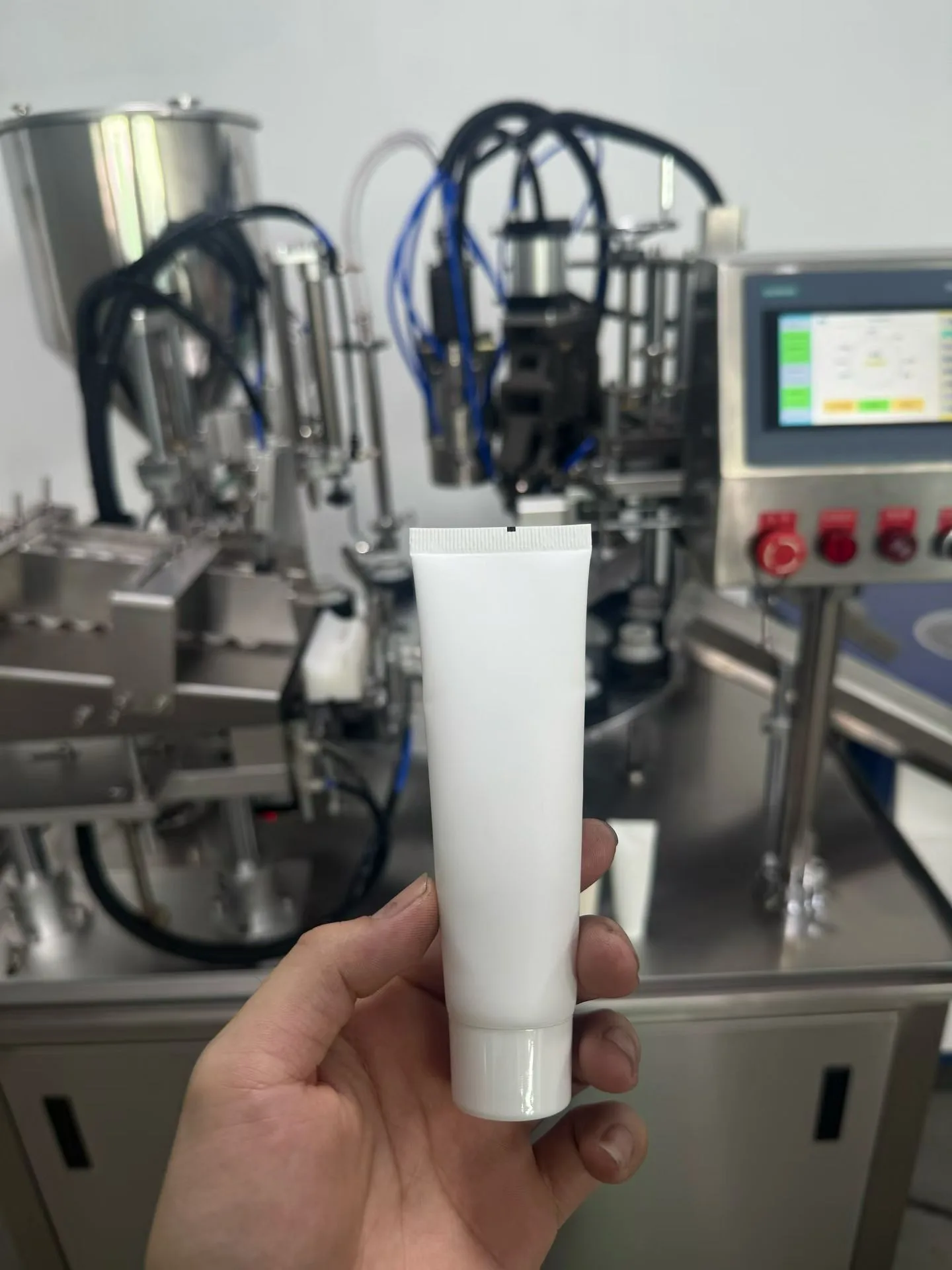
A single-dose tube filling machine fills and seals tiny one-use tubes — the 0.2–2.5 ml single-use ampoules used for cosmetic serums, essences and single-use samples. Because the dose is so small, ordinary piston fillers are too coarse. This is a niche, high-precision machine that very few manufacturers build — which is why it is one of HTKC’s differentiators.
This page explains what the format actually is, why a standard tube filler cannot serve it, what the machine does station by station, what output you can expect in real production, and what to confirm before you order.
What “single-dose” means
Single-dose tubes are one-use packages, usually supplied as a five-row connected strip that the customer provides. They hold a single application of serum, essence, eye drop or other flowable liquid, and are sealed at the factory so the dose stays intact until the moment of use.
The format behaves differently from a normal tube in three ways that matter to the machine design:
- It arrives as a strip, not as individual tubes. Five tubes sit side by side on a common web, so the machine indexes a row at a time — five fills per cycle, not one.
- The tube is already formed. There is no tube loading in the sense of a normal line; the strip is fed from a magazine, and the sealing and cutting happen on the web.
- The fill volume is small enough that dead volume matters. At 0.2–2.5 ml, a few tenths of a gram lost in the pump and the nozzle is a visible share of the dose.
Why it needs a different filling technology
A 0.2–2.5 ml fill volume is far below a normal 10–200 ml tube filler. A standard piston is not precise enough at this scale, so the machine uses a ceramic pump instead. Ceramic is precise, wear-resistant and suited to the very small, consistent dose, delivering ±0.05 g accuracy.
The reason is mechanical rather than a matter of brand. A piston filler works by displacing a fixed cylinder volume; at 1 ml the seal friction, the valve seating and the elasticity of the product line all become large relative to the dose. A ceramic pump meters through a ceramic rotor and stator with a very tight clearance, and ceramic does not swell or wear the way a polymer seal does when it meets essential oils, alcohol or low-viscosity serums. That is why the accuracy figure holds over a production shift instead of drifting.
If you want the general version of this argument — what ±1 g and ±1% mean on a normal tube line and how accuracy is verified — it is covered separately in fill accuracy explained.
The HTKC single-dose machine
- 8-station rotary filling die.
- Vibrating-bowl tube feeding → robotic tube loading → filling → ultrasonic sealing → tail cutting → robotic discharge.
- 26–32 rows/min, 0.5–0.6 MPa air pressure, PLC + touch screen control.
- Flowable-liquid filling with a ceramic pump.
Reading the sequence in order is the quickest way to see where the engineering effort sits. Feeding and loading are automated because at this size manual handling is not viable — a 0.2 ml tube is too small to place by hand at production speed. Sealing is ultrasonic because the web is thin and the seal must be clean without a hot jaw touching product that has just been dosed. Tail cutting and discharge are automated for the same reason as loading: the parts are too small to handle at rate.
What output looks like in real production
The rated figure is 26–32 rows per minute. Because a row carries five tubes, that converts to roughly 130–160 tubes per minute at rated speed. In practice, plan on a production efficiency of about 85% once you allow for reel changes, start-up checks and stops:
| Shift length | At 26 rows/min | At 32 rows/min |
|---|---|---|
| 1 hour (rated) | 7,800 tubes | 9,600 tubes |
| 8 hours at 85% efficiency | 53,000 tubes | 65,000 tubes |
Those numbers are arithmetic from the rated row rate and an efficiency assumption — treat them as planning figures, not a guarantee. The useful conclusion is the scale: this is a machine for tens of thousands of doses per shift, not millions. If your sample programme needs millions of units a month, single-dose strip filling is the wrong format and you should be looking at small bottles or sachets instead.
Single-dose strip vs a normal tube line
| Item | Single-dose machine | Normal tube filler |
|---|---|---|
| Fill volume | 0.2–2.5 ml | 10–200 ml |
| Dosing | Ceramic pump, ±0.05 g | Servo piston, ±1 g |
| Tube feed | Five-row strip, magazine + robot | Individual tubes, bowl + robot |
| Sealing | Ultrasonic on the web | Heat or ultrasonic |
| Output | 26–32 rows/min | 20–50 tubes/min |
| Who supplies the tube | Customer-supplied strip | Customer-supplied tube |
Who should buy it
- Cosmetic brands launching sample sets or travel sizes.
- OEM/ODM manufacturers running single-dose serum lines.
- Producers of single-use eye drops and medical cosmetic ampoules.
- Brands that currently buy pre-filled single-dose strips from a converter and want to bring filling in-house as volume grows.
Six things to confirm before ordering
- The strip drawing. Row pitch, tube diameter, tube length and the number of rows per reel decide the tooling. Send the drawing, not a description.
- Fill volume range and the target weight. A machine set for 1 ml is not automatically good at 0.2 ml; state the range you will actually run.
- Product viscosity and whether it is flammable or alcohol-based. This drives pump material and the electrical specification.
- Air supply. The machine runs at 0.5–0.6 MPa; confirm your compressor can hold that at the machine, not just at the receiver.
- Seal integrity test method. Agree in advance how a sealed strip will be checked — squeeze test, dye penetration or a pressure decay check.
- Reel change routine and time. Ask for the number, because at 26–32 rows a minute the reel ends sooner than buyers expect.
Common questions
Can it fill both serum and thin liquid?
Yes — it handles flowable liquids, with the ceramic pump set to the required dose. Very high-viscosity products are not the target application; if your product does not flow at ambient temperature, this is the wrong machine.
What tube format does it take?
Customer-supplied five-row connected strips. The strip is the format constraint — we can build the tooling around your strip, but we cannot change the strip to fit a standard tool.
Why ultrasonic sealing rather than heat?
The web is thin and the seal sits millimetres from freshly dosed product. Ultrasonic fuses the material without a hot jaw pressing into the seal zone, which keeps the seam clean and avoids product being pushed into it.
Is the machine a niche product?
Yes. Very few manufacturers build single-dose strip fillers, which is why buyers often end up buying pre-filled strips from a converter instead. If you are evaluating bringing this in-house, the volume threshold is the first thing to settle.
Related guides
- Fill accuracy: what ±1 g and ±1% really mean
- Machine output: picking the right speed for your volume
- Small-batch and pilot production on a tube line
- The complete guide to tube filling & sealing machines
Running single-dose serums or samples? Send your tube strip format and fill volume for a quote on the niche machine most suppliers don’t build.