From US$1,000 · FOB Guangzhou
Final price depends on tube or pouch size, material and output. Send your sample specification for an exact quote.
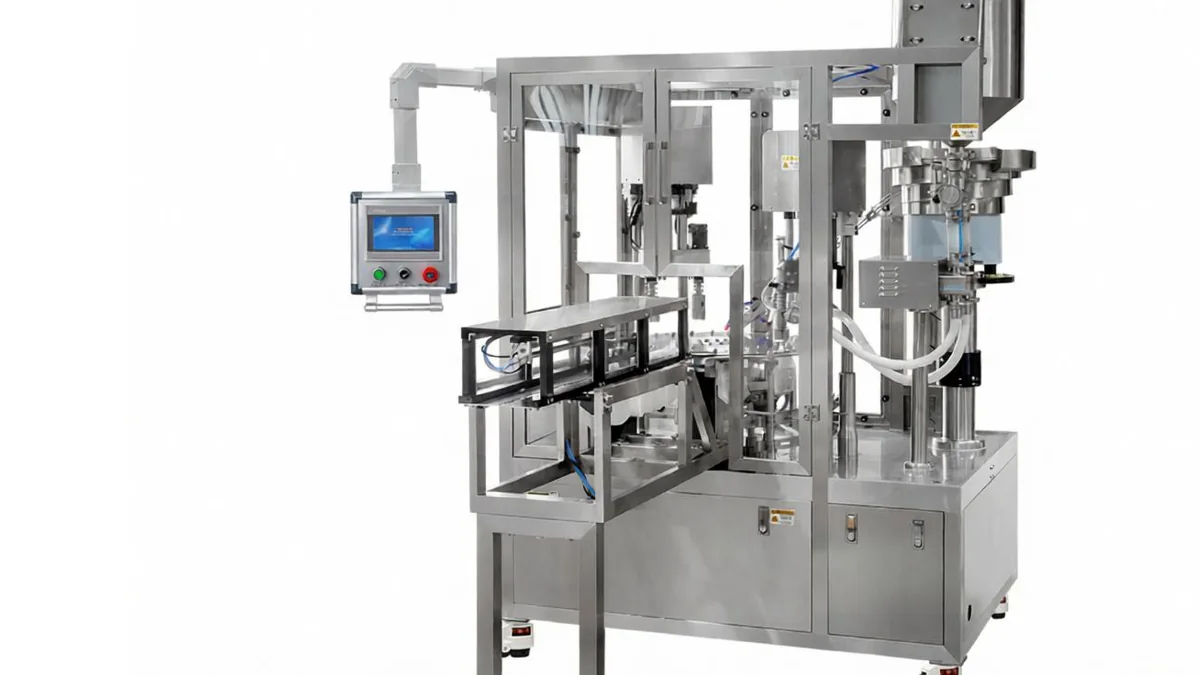
A spouted pouch filling and capping machine fills your product through the spout and seals the cap in one continuous pass — no open bag, no manual handling, no headspace you have to fight afterwards. This dual-head platform is built for sauce, dairy, cosmetic and home-care pouches, where the same line has to run several SKUs a week and changeover time decides whether the machine pays for itself.
On the Machine
What the machine actually does
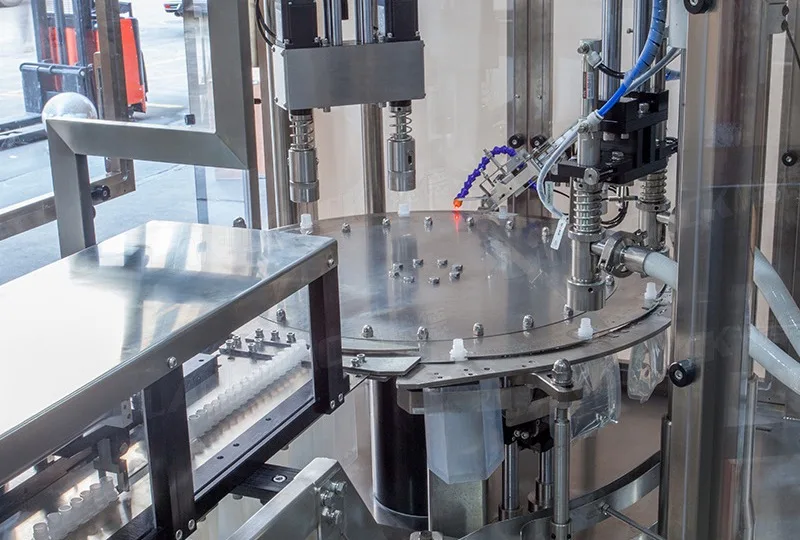
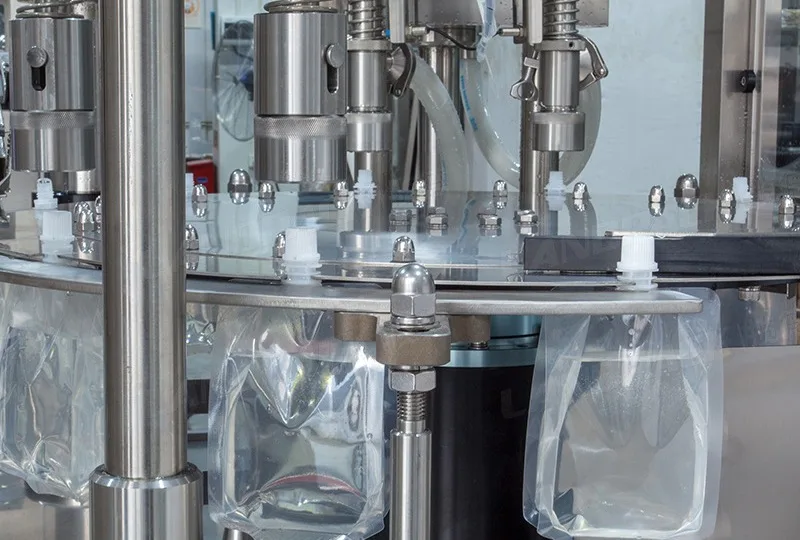
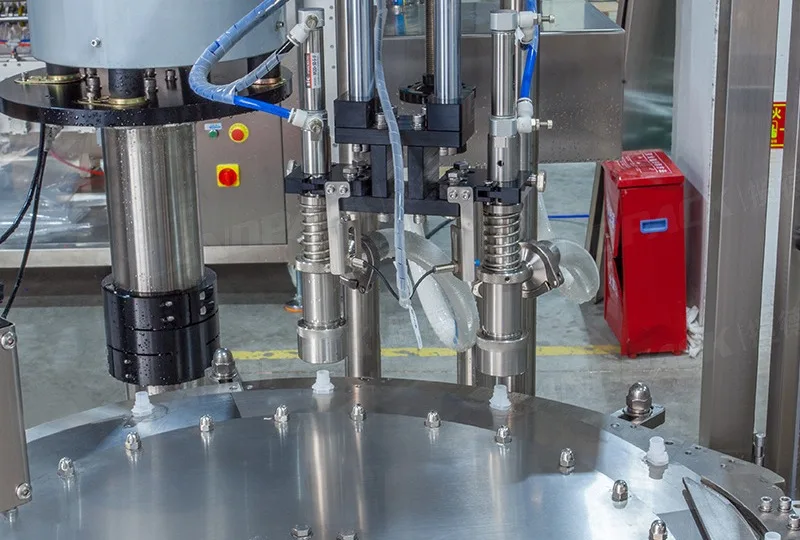
Pouches enter the machine flat, are separated by the indexing conveyor and presented to the filling station spout-up. Two filling heads dose simultaneously, so the machine does two pouches per cycle instead of one. The filled pouch then moves to the capping station, where the cap is placed and torque-tightened, and finally leaves the machine ready for cartoning or shrink wrapping.
Because dosing is volumetric through the spout, the product never touches an open surface. That is what keeps sauces and dairy from picking up air, and what makes the sealed pouch shelf-stable without a separate pasteurisation step for the headspace.
Ready to price your pouch? Send the spout diameter, the fill volume and the product viscosity — that is enough for us to quote.
From flat pouch to capped pouch
Machine parameters
We do not publish a single output figure for this machine, because output on a spouted pouch line is set by fill volume, product viscosity and cap style, not by the machine alone. Give us the pouch and the product, and we will confirm the realistic hourly output in writing before you order.
Products it runs
If your product carries solids, is very high viscosity, or needs hot fill, say so up front — the dosing system and the spout path change accordingly.
What to send us for an accurate quote
Where it fits in a line
The pouch and the cap both arrive finished; this machine only fills through the spout and closes it. That makes the line around it simple — and it also means most quality problems start before the pouch ever reaches the machine.
| Stage | What happens | What it needs from you |
|---|---|---|
| Upstream | Pre-made spouted pouches in the magazine, caps in the cap feeder. Pouches have to be flat and spout-up in the stack to feed at all. | Pouches from a supplier who holds dimensional tolerance, and caps to the same thread spec — mixed cap lots are the usual cause of torque faults |
| This machine | Pouch pick → spout presented to the filling head → dual-head atmospheric dosing → cap press and torque → discharge. | Fill volume, product viscosity, and the torque your cap needs to seal without cracking |
| Downstream | Capped pouches to a collection tray, a cartoner, or a case packer. | Space at the discharge end for whatever comes next |
| Optional | Coding on the cap or on a printable panel of the pouch. | Where the code has to go, and whether the pouch has a panel that will take it |
Installation: what the site has to provide
- Power — 7.5 kW. Confirm the supply on site — this is the heaviest machine in the range.
- Air — Required for the pneumatic stations. Pressure and consumption depend on head count and conveyor length, so they are confirmed on the layout drawing rather than quoted as a single figure.
- Floor — Footprint depends on head count and conveyor length; the layout drawing is issued with the quotation so it can be checked against the space you actually have.
- Hygiene — Stainless frame with washable surfaces. If the product is food or pharmaceutical, say so at enquiry — surface finish, guarding and documentation change, and retrofitting them later is expensive.
Changeover: what changes with a new tube or a new product
- Pouch format — clamps and spout guides, quoted against your pouch drawing. Width and spout position both matter, and a tolerance change from the supplier can be enough to stop reliable feeding.
- Fill volume — dosing time, saved as a recipe.
- Cap type — torque head and press depth. A different cap supplier is a different changeover, even with the same nominal thread.
Two heads do not double output on a viscous product. Dosing time sets the cycle, and a second head only helps if the product flows fast enough to fill both inside one cycle — which is why the honest answer to “how fast is it” depends on the product, not the machine. This guide compares how different product types load a filler, and the machine index puts this one next to the tube machines it often runs beside.
Troubleshooting: what the symptom tells you
The spouted pouch station fails in a different way to a tube machine: the pouch and the cap arrive pre-made, so the machine can only be blamed for dosing, cap torque and pouch location.
Pouches and caps arrive pre-made, so half the faults on this station are incoming-material faults. Test the incoming lot before adjusting the machine.
Questions buyers ask before ordering
Can one machine run several pouch sizes?
Does it fill and cap, or only fill?
How accurate is the fill?
What about spare parts and support?
Related guides
- Tube vs bottle vs jar filling — how packaging decides the machine
- How much a tube filling machine costs
- Importing a tube filling machine from China
- Small-batch filling for startups & pilots