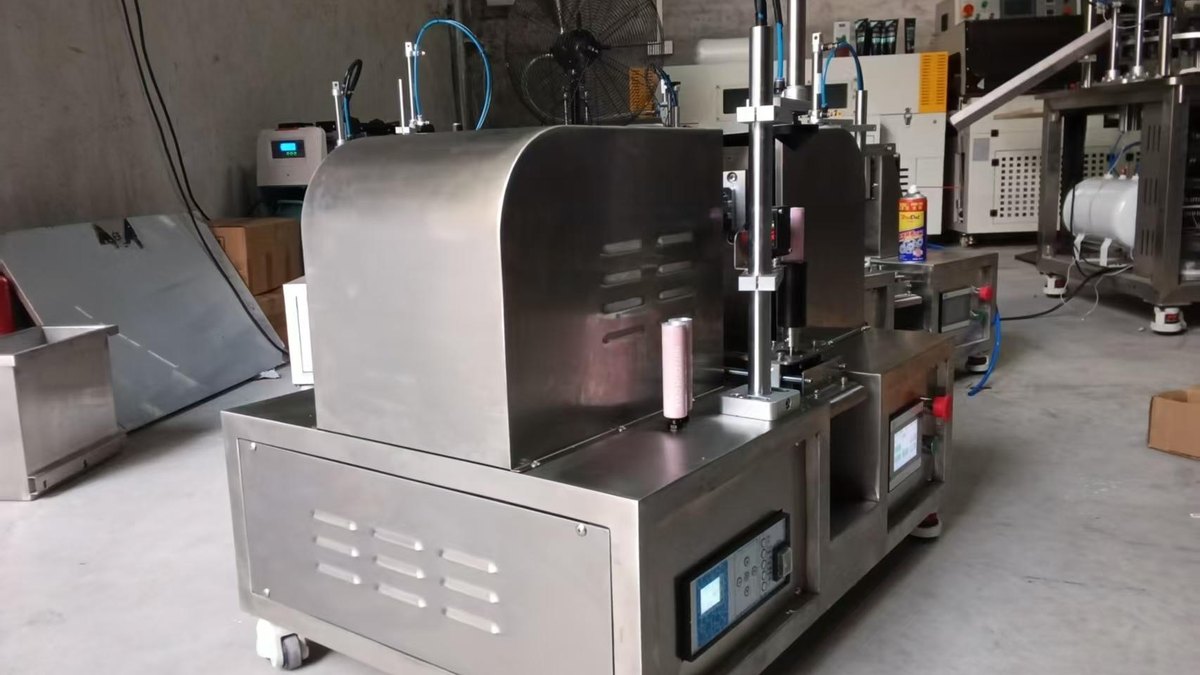
HTKC builds tube filling and sealing machines at our factory in Guangzhou, China, and supplies cosmetics, pharmaceutical and food producers across the Middle East, Latin America and Central Asia. This page is for buyers in those markets who want a direct manufacturer — not a trading agent — with export documentation, voltage and language support already handled.
Why buy factory direct
- One manufacturer from specification to shipping — no agent mark-up, one point of accountability.
- Real machine specifications, not resold catalogue pages: ultrasonic, heat sealing, aluminium folding, single-dose, spouted pouch and shrink wrapping.
- Guangzhou, China — a major packaging-machinery manufacturing hub with established export logistics.
Built for your markets
- Voltage: 220 V 50 Hz standard, with options to match your local supply.
- Language: English manuals, technical documentation and remote video support.
- Shipping: wooden-crate export packing, FOB Guangzhou, freight on the buyer’s account — we prepare the export paperwork.
The machine range
| Machine | Process | Key spec |
|---|---|---|
| TY-001 semi-automatic | Ultrasonic sealing | 7–13 tubes/min, 15–50 mm ø |
| TY-006 fully automatic | Ultrasonic sealing | 10-station rotary, 10–150 ml |
| HT220 fully automatic | Heat sealing | 20–50 tubes/min, 16–50 mm ø |
| AT300-A | Aluminium folding | Metal tube crimping |
| Single-dose | Ceramic-pump filling | 0.2–2.5 ml, ±0.05 g |
| Spouted pouch | Fill & capping | Dual-head, ±1% |
| Pillow-type shrink | Shrink wrapping | 30–150 packs/min |
What buyers in your region ask us
Lead time — typically 25–30 days after the deposit is received (excluding public holidays).
Payment — 50% deposit on signing, balance before shipment.
After-sales — remote video support, with operator training available at our factory.
How to get a quote
Send us your tube material, diameter, fill volume, target output and destination country. We reply with a matched configuration and an FOB price.
Voltage, climate and the specification changes that follow
The factory standard is 380 V three-phase at 50 Hz. Most of the Gulf and Central Asia matches it; parts of Latin America run 220 V three-phase at 60 Hz; a few sites are on 440 V. On a 60 Hz supply a 50 Hz motor runs roughly a fifth faster, which is fine for a conveyor and not fine for a pump sized for the slower speed — so the voltage is a question to answer before the frame is built, not after it lands.
Climate matters in three places. Ambient above about 40 °C pushes a sealed electrical cabinet toward its thermal limit, so the cabinet needs a bigger exchanger or an air conditioner rather than a fan. Fine dust — common in the Gulf and in Central Asian plants — gets into pneumatic cylinders and jaw mechanisms, and the answer is bellows on the rods and a filter-regulator serviced on a schedule. Humidity changes how a laminated tube behaves in storage before it ever reaches the machine.
None of these is exotic; all of them are cheap at order stage and expensive as a retrofit. Say the destination and the ambient conditions in the enquiry and they get built in.
Spare parts, response time and the real distance problem
The genuine difficulty of buying from Guangzhou is not the machine, it is the week you wait for a jaw facing. Two habits remove most of it. First, ship a wear-parts kit with the machine: seals, jaw facings, a trim knife, a spare nozzle. The box costs very little and the freight is already paid. Second, agree in writing which parts are air-freightable in 3–5 days and which are sea-only, so nobody discovers at 2 a.m. that the answer is six weeks.
Remote support is worth more than it sounds if it is structured. A video call with the technician looking at the HMI alarm screen resolves a surprising share of faults without a flight. Ask before you buy whether the supplier will do that, in what language, and in which time zone — a factory that answers at 09:00 Guangzhou time is answering at 04:00 in Riyadh and 21:00 the previous day in São Paulo.
What to put in the enquiry so the quote is usable
Most enquiries that stall stall on the same four points. Include them and the first reply is a price rather than a question:
- Tube or pouch specification: diameter, length, material (ABL, PBL, PE), and fill volume in ml or g.
- Output required: tubes per shift or per day, and your shift pattern — not just “fast”.
- Destination and power: country, port, voltage, frequency, ambient temperature.
- Documentation: certificate of origin needed for a trade agreement, CE for Europe, and the language for the manual and nameplate.
The four platforms and their output ranges are listed on the machine range page; the terms importers ask about most — FOB, CIF, CO, HS code — are defined in the glossary, and the shipment side is covered in importing a tube filling machine from China.
Related guides
- How to specify a tube sealing machine
- Tube filling machine by product type
- The complete guide to tube filling & sealing machines
- Turnkey tube filling line from specification to shipment
Get a direct factory quote — send your tube spec and destination country today, and we will recommend the exact machine for your market.